
AI for Marketers: Audience Segmentation and Targeting That Works
AI audience segmentation and targeting uses machine learning to group customers and reach them from live behavioral data, not the static demographic buckets marketers relied on for decades. If you want an AI marketing mentor to guide the shift, the payoff is concrete: instead of guessing who your best prospects are, models find them and keep the segments fresh automatically.
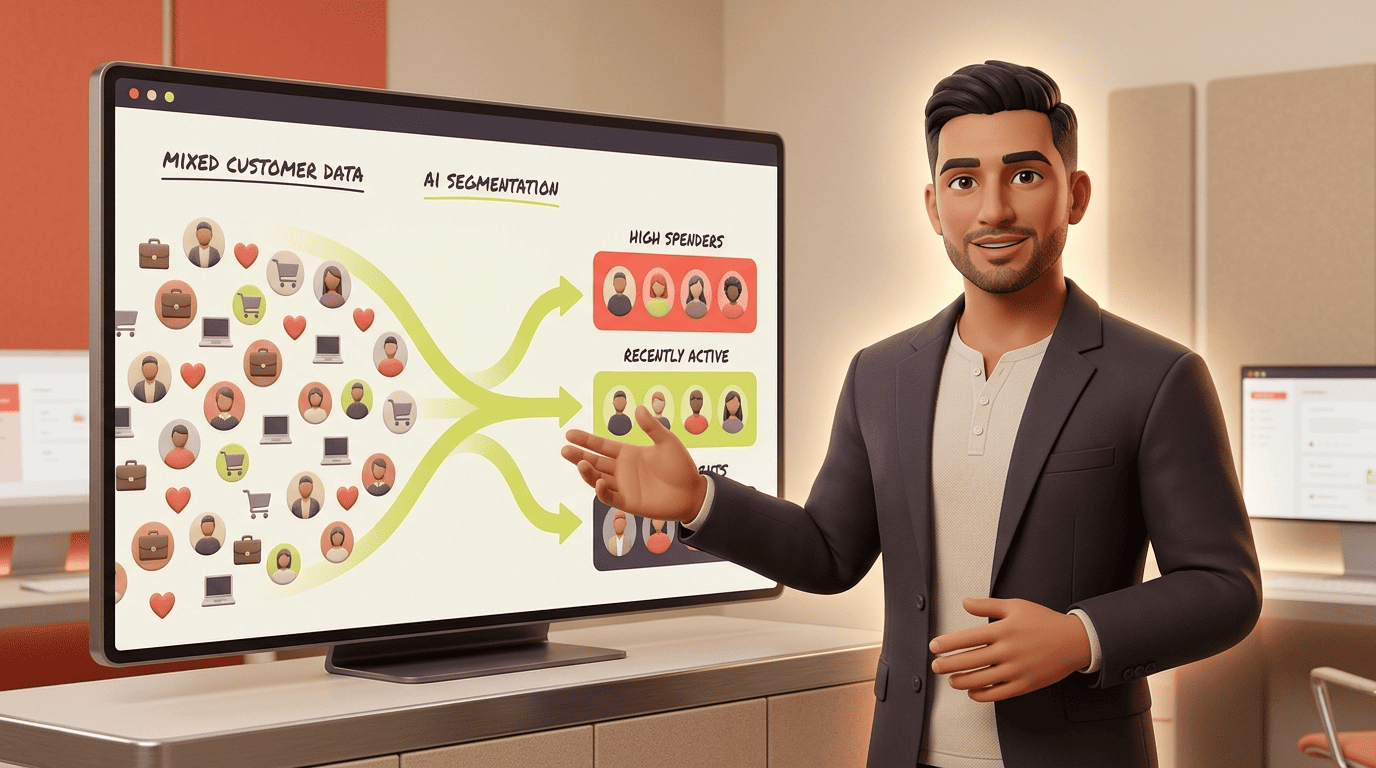
This is no longer a fringe tactic. A 2023 Deloitte survey found that 64% of high-growth brands used AI for audience segmentation and targeting, compared with just 15% of negative-growth companies. This guide covers what AI segmentation really is, the five types that power it, the ROI numbers behind it, a step-by-step workflow, and the risks to manage.
What AI Audience Segmentation and Targeting Really Is
AI audience segmentation is the practice of using machine learning to sort customers into groups based on the signals in their data, then targeting each group with the right message. The idea of dividing a market into segments dates back to market segmentation theory from 1956, but doing it by hand meant broad, slow, and quickly outdated buckets.
AI changes the mechanics. Instead of a marketer writing rules, machine learning analyzes thousands of behavioral and contextual signals at once and finds patterns no human could sort manually.
From demographics to living data
Traditional segmentation splits an audience by broad demographics like age, location, or income. It is static: once you build a list, it starts going stale the moment customer behavior shifts.
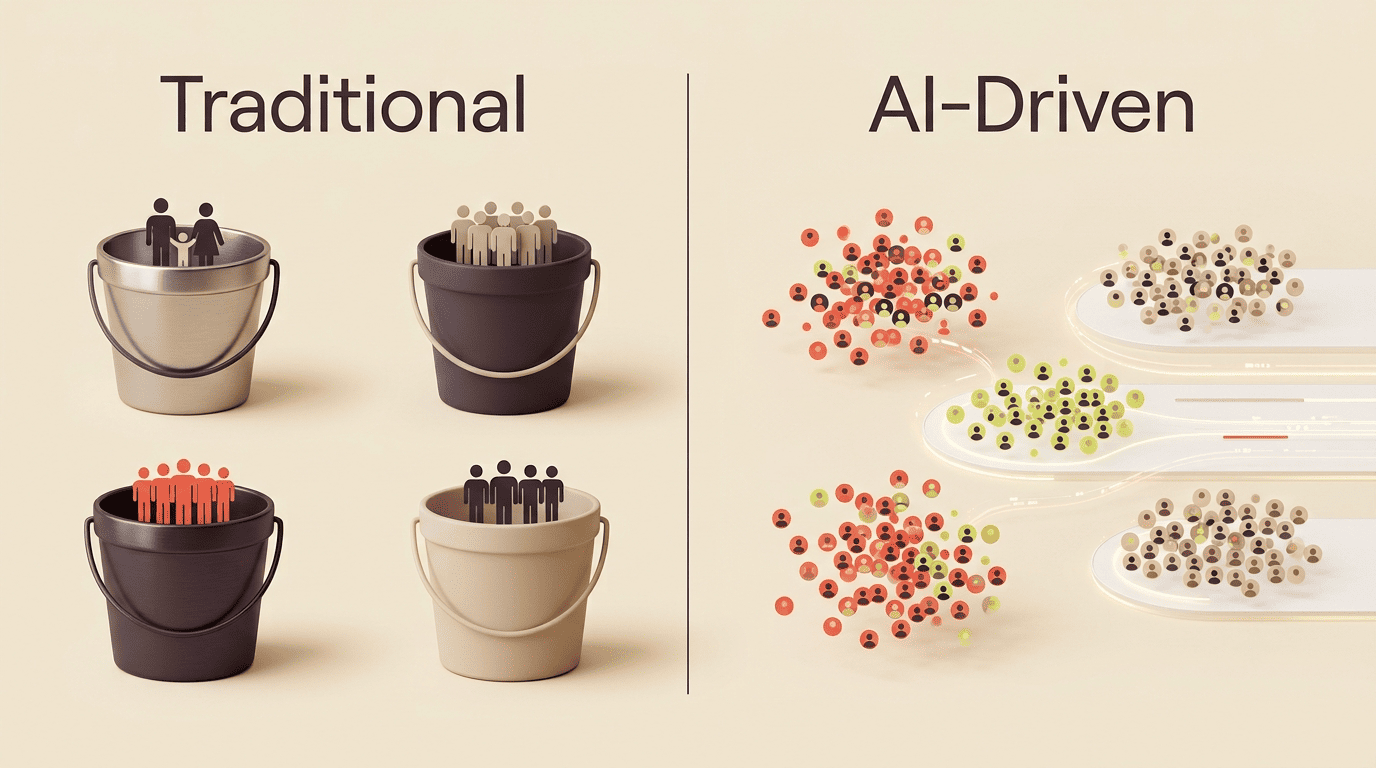
AI-driven segmentation works from living data. It weighs purchase frequency, content preferences, response timing, and dozens of other signals, then updates the groups as new data flows in. That is why practitioners call it dynamic rather than fixed.
AI vs traditional segmentation
The gap shows up in how decisions get made. Rules-based segmentation depends on a marketer’s assumptions, while machine learning segmentation lets the data reveal the groups.
The need is real: Pecan AI reports that 49% of marketers frequently feel they are guessing when making decisions, and 100% of the marketing decision-makers it surveyed wanted expanded AI capabilities. Behavioral targeting removes much of that guesswork.
How AI Segmentation Works: 5 Types
AI segmentation is not one technique but several, each reading a different kind of signal. Most modern platforms combine them rather than using just one.
| Type | What it does | Signal it reads |
|---|---|---|
| Predictive | Forecasts future behavior | Churn risk, purchase intent, LTV |
| Behavioral | Groups by actions | Clicks, purchases, timing |
| Dynamic | Refreshes segments in real time | Live incoming data |
| Lookalike | Expands reach to similar users | Traits of your best customers |
| Clustering | Finds hidden groups | Patterns across all data |
Predictive and behavioral segmentation
Predictive segmentation forecasts what a customer will do next, such as churn, purchase intent, or lifetime value, so you can act before the behavior happens. Behavioral segmentation groups people by what they actually did, including click patterns, purchase history, and response timing.
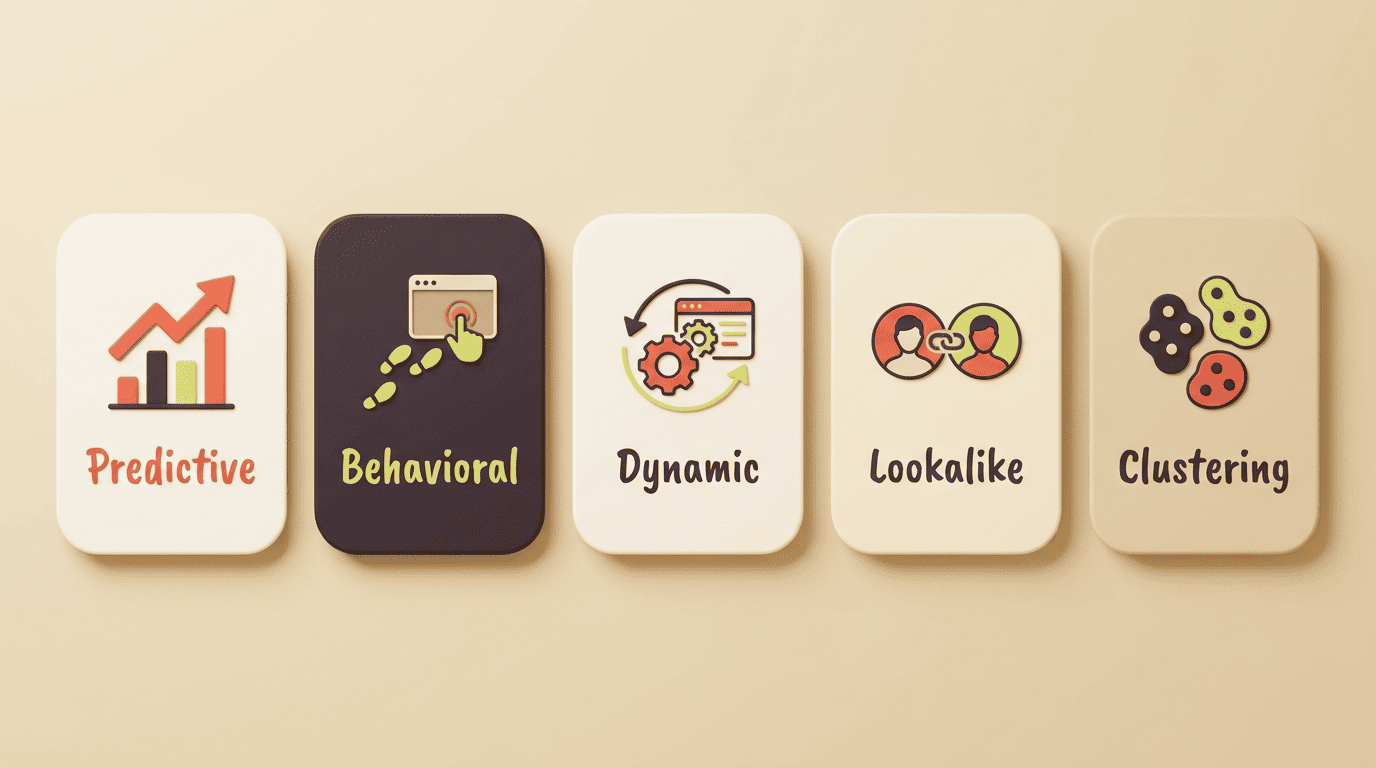
Together these two form the backbone of intelligent audience development. They replace the assumption that everyone in a demographic behaves the same way with evidence of how each person actually engages.
Dynamic, lookalike, and clustering
Dynamic segmentation keeps groups current by updating them automatically as new data arrives, so a segment reflects this week’s behavior, not last quarter’s. Lookalike modeling expands reach by finding new prospects who resemble your highest-value customers.
Clustering is the machine-learning engine underneath much of this: it discovers natural groupings in the data without a marketer defining them first. That is how data-driven customer clustering surfaces micro-segments a rules-based approach would miss.
Why It Matters: The Business Case
The move to AI-powered segmentation is driven by results, not novelty. When targeting gets more precise, acquisition costs fall and return on ad spend climbs.
The efficiency gain is structural. AI finds subtle differences between customer groups and scales that precision across millions of people, while cutting the hours teams spend on manual data wrangling and rule-setting. That frees marketers to focus on creative strategy instead of list maintenance.
Companies that grow faster drive 40 percent more of their revenue from personalization than their slower-growing counterparts.
McKinsey & Company
The numbers on ROI
The performance data is consistent across sources. Personalization powered in part by AI segmentation can cut acquisition costs by up to 50%, lift revenue by 5-15%, and boost marketing ROI by 10-30%, according to McKinsey.
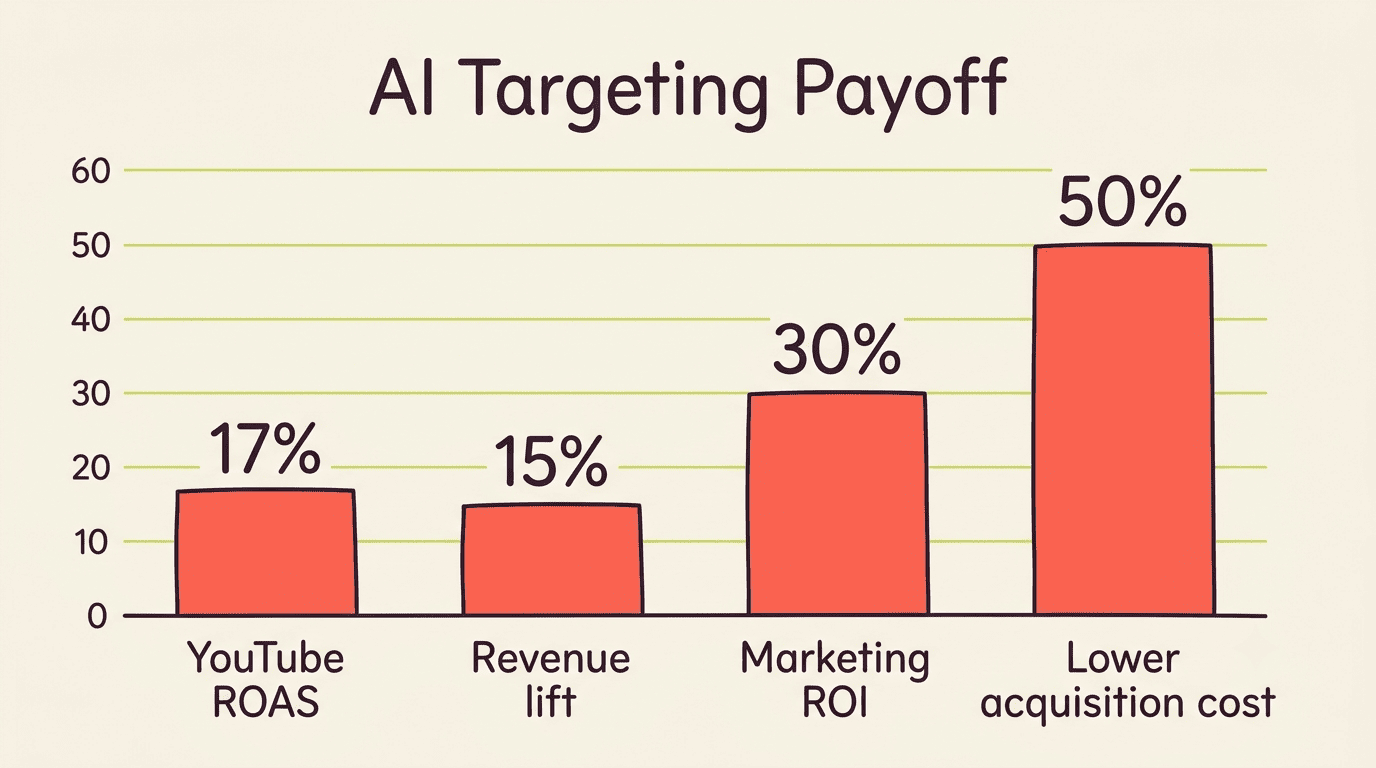
Ad performance follows the same pattern. A Nielsen analysis found AI-driven YouTube campaigns delivered 17% higher return on ad spend than manual campaigns, and connected-TV platform MNTN reports that its AI-matched audiences produce 6x more site traffic, 2x higher ROAS, and half the cost per acquisition.
Real-World Use Cases
The theory becomes practical in a handful of high-value plays that most teams can run. These are the workflows where AI targeting pays for itself fastest:
- Predicting customer churn so you can intervene with retention offers before people leave.
- Assessing lifetime value to invest more in the customers who will be worth the most.
- Identifying VIP customers and their preferences to personalize high-touch treatment.
- Building lookalike audiences that expand reach to prospects resembling your best buyers.
Churn, lifetime value, and VIP identification
Churn prediction flags the accounts most likely to lapse, turning retention from a reaction into a plan. Lifetime value scoring ranks customers by long-term worth so budget flows to the highest-return relationships.
The scale behind these plays is enormous. MNTN reports analyzing more than 1 trillion behavioral signals daily and making 300,000 bidding decisions per second, a volume that only automated systems can process.
Lookalikes and cross-channel reach
Lookalike modeling turns your best customers into a blueprint for finding more like them, expanding reach without lowering quality. Once segments exist, activation across channels is what makes them useful.
Identity and activation platforms extend that reach widely: LiveRamp, for example, connects audiences across more than 500 destinations and a footprint covering over 92% of consumers’ digital time. The segment is only as valuable as the channels you can act on.
How to Implement AI Segmentation: A 5-Step Workflow
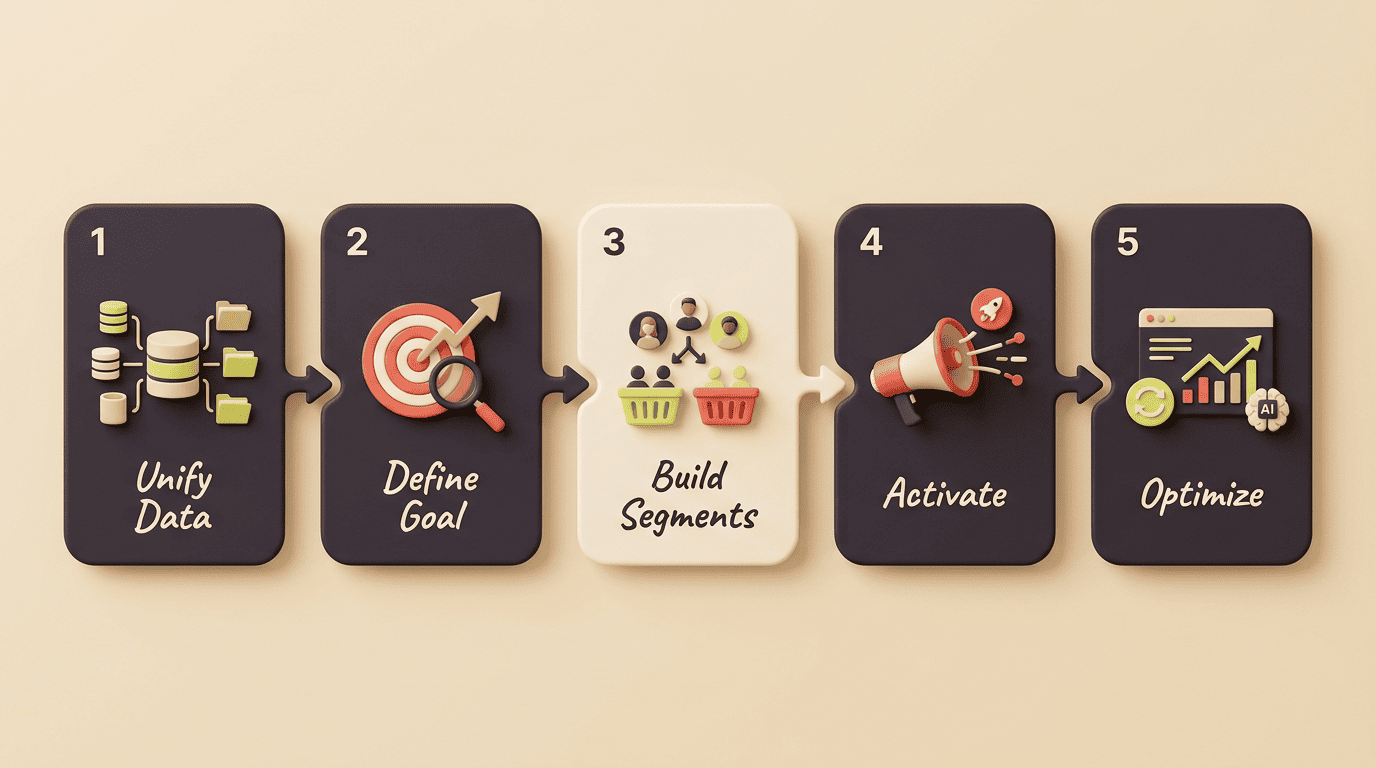
Getting started is a sequence, not a single purchase. This five-step workflow takes you from scattered records to live, self-improving segments:
- Unify your data. Pull CRM, website, social, and purchase-history data into one customer data platform so models see the full picture.
- Define an outcome. Choose a clear goal, such as reducing churn, raising lifetime value, or lifting conversion, before you build anything.
- Let machine learning build segments. Use clustering and predictive models to form dynamic groups instead of hand-written rules.
- Activate across channels. Push each segment to email, social, search, and CTV where its members actually spend time.
- Optimize in real time. Feed results back so the system refines segments and targeting continuously.
Start with one high-impact use case rather than trying to automate everything at once. A single proven win, like an AI-driven churn-prevention flow, makes the case for expanding to the rest of your channels.
Challenges and Responsible Use
AI targeting is powerful, but it carries real risks that marketers have to manage deliberately. Ignoring them turns a competitive edge into a liability.
Data privacy comes first. Regulations like GDPR and CCPA govern how you collect and use customer data, and the FTC enforces privacy standards for US businesses. Consent and transparency are not optional add-ons.
Bias and data quality shape the output. Algorithms can inherit bias from skewed training data, and the «black box» nature of some models makes decisions hard to explain. Above all, poor data produces poor segments, so accuracy and governance decide whether AI targeting helps or harms.
FAQ
Related guides: content creation and copywriting and AI chatbots for customer engagement.