
AI for Marketers: Content Creation and Copywriting (A Practical Guide)
AI now drafts, edits, and repurposes marketing copy in minutes, and a majority of marketers already rely on it to do so. Most marketing teams lean on using AI in marketing to keep pace with content demand, and the shift happened fast.

This guide walks a marketer through what AI content creation actually means, which tools are worth paying for, how to write prompts that produce usable copy, a repeatable workflow you can run every week, and how to keep quality and compliance under human control.
What AI content creation and copywriting actually mean
AI copywriting uses large language models to turn a short prompt into a full draft — a headline, a product description, or an entire blog post — in the tone and format you specify. The technology behind it, generative AI, is built on models trained to predict and generate human-like text, and its scope goes well beyond marketing copy.
From prompt to copy: how it works
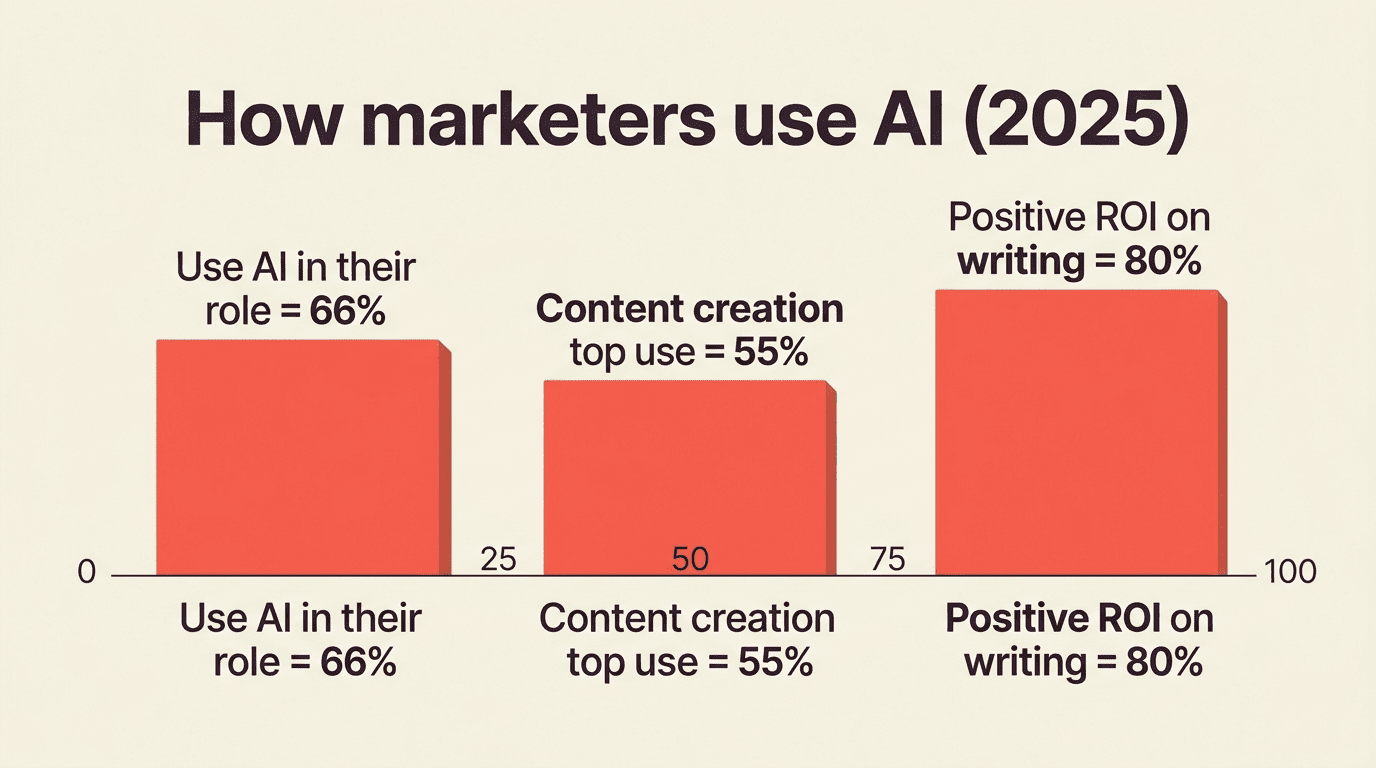
AI copywriting means prompting a generative model — built on large language models and natural language processing — to output human-like copy within parameters you set: audience, tone, length, format. It behaves as a co-writer, not an autopilot; the model proposes a draft, and a person still decides what ships. That division of labor is already the norm rather than the exception: content creation is the single most popular use case for AI in marketing, cited by 55% of marketers — up 12 points year over year — and 74% of marketers agree AI tools make them more productive in their roles, according to HubSpot’s 2025 AI Trends report.
Why it matters for marketers now
The adoption curve keeps climbing. 66% of marketers globally now use AI in their roles, and nearly 80% say generative AI delivers a positive ROI specifically on content-writing tasks, according to HubSpot’s 2025 research. The economic case extends past marketing budgets, too — J.P. Morgan Research estimated that generative AI could add up to 10% to global GDP as it reshapes knowledge work across industries.
What kinds of content can AI write?
Generative tools handle a wide range of marketing formats, but they are not equally strong at all of them. Understanding where AI adds the most speed — and where it still needs a firm editorial hand — determines whether the output is publish-ready or just a rough sketch.
| Content type | AI strength | Human touch needed |
|---|---|---|
| Ad and headline copy | High — fast variations | Medium — pick the winning angle |
| Product descriptions | High — scales across SKUs | Low — spot-check accuracy |
| Social media captions | High — volume and tone matching | Medium — brand voice consistency |
| Blog posts and outlines | Medium — strong first draft | High — fact-check, original insight |
| Landing-page copy | Medium — structure and clarity | High — conversion strategy, offer framing |
| Email subject lines | High — rapid A/B variants | Low — final tone check |
The high-value content types
AI performs best on ad copy, headlines, product descriptions, social captions, email subject lines, and blog outlines or first drafts. Content creation overall is marketers’ single most common AI use case, and research support is another leading application — cited by 47% of AI-using marketers, according to HubSpot’s 2025 research. Across these formats, AI shines at generating volume, producing variations quickly, and clearing the blank-page problem with a usable first draft.
Where humans still lead
Brand voice nuance. A model can imitate a style guide, but it does not internalize why a brand sounds the way it does — that judgment call stays with a human editor.
Emotional storytelling and strategic angle. AI can assemble sentences that follow a narrative structure, but choosing which story to tell, and why it will resonate with a specific audience, remains a human decision.
Original research and fact accuracy. Models generate plausible-sounding claims that are not always true, so verifying data points, statistics, and quotes before publishing is non-negotiable.
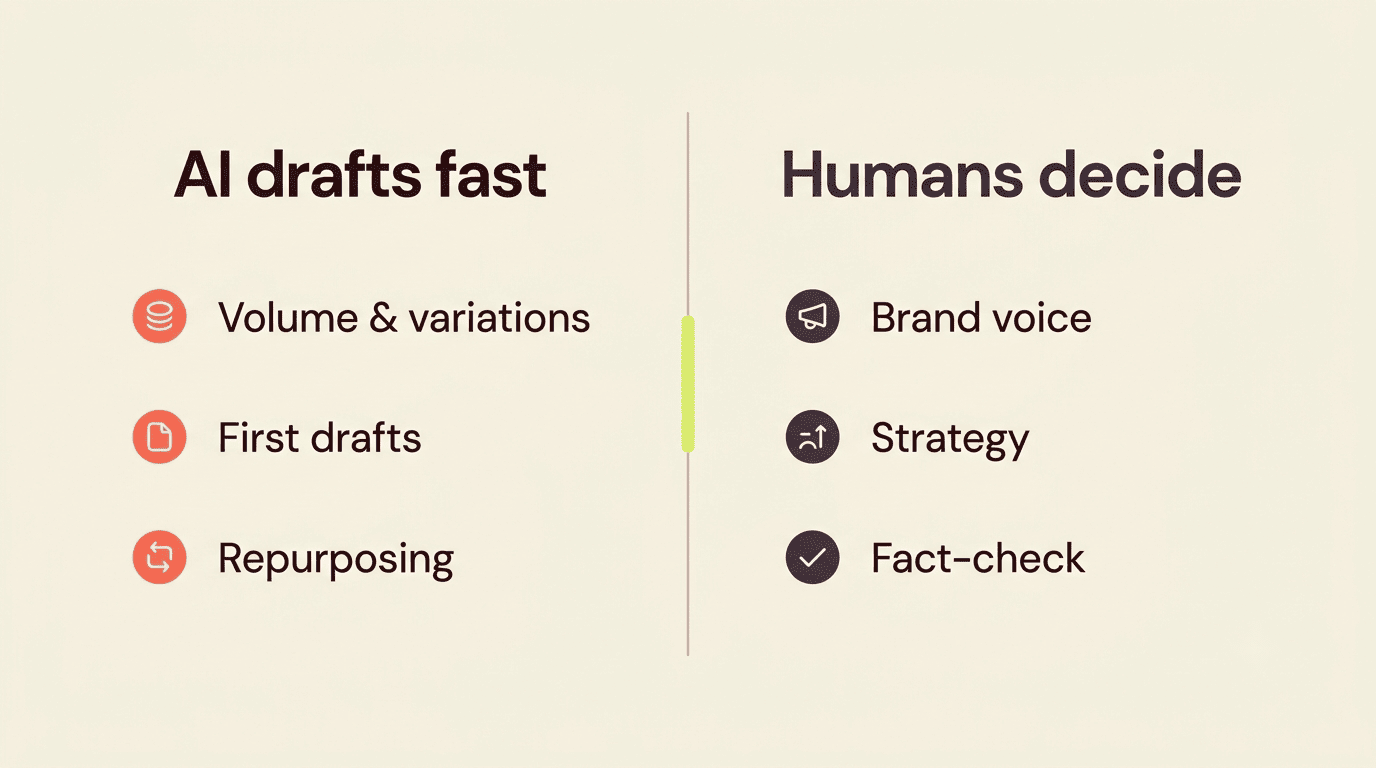
A useful rule of thumb is the 80/20 split: let AI handle roughly 80% of structural drafting — outlines, first passes, variations — and invest human expertise in the 20% that carries voice, strategy, and judgment.
The best AI tools for content and copywriting
Marketers now choose between general-purpose assistants and marketing-native platforms, and the two categories solve different problems. Picking the wrong one for the task usually shows up as either a generic-sounding draft or a slow, expensive workflow.
General LLMs vs marketing-specific tools
General assistants — ChatGPT, Claude, Google Gemini — are flexible and strong at tone, reasoning, and long-form structure, which makes them a good default for drafting and editing almost anything. Marketing-native platforms such as Jasper and Copy.ai add templates, brand-voice memory, and campaign workflows purpose-built for repeatable content production. A third category covers editing and optimization, while visual generators round out the toolkit for teams that need copy and imagery together.
- General LLMs: ChatGPT, Claude, Google Gemini.
- Marketing-native platforms: Jasper, Copy.ai, Writesonic.
- Editing and optimization: QuillBot, SurferSEO.
- Visual generation: Canva Magic Write.
How to choose
Match the tool to the task rather than picking one platform for everything. A general LLM is the better choice for reasoning-heavy or long-form work, since it can hold more context and adjust tone on the fly; a marketing-specific tool pays off when a team runs the same campaign template — a product launch email, a set of ad variants — over and over and needs brand-voice consistency baked in. Pricing across the category is fairly narrow at the individual and small-team level: most standalone plans run roughly $20–$100 per month, with enterprise and multi-seat tiers running well above that — still generally below the cost of the time these tools save on first drafts. When the goal is organic traffic, feed those drafts into an AI-powered SEO workflow so the copy is built to rank, not just read well.
| Tool | Best for |
|---|---|
| ChatGPT | General drafting, reasoning, long-form structure |
| Claude | Long documents, nuanced tone, editing |
| Google Gemini | Research-backed drafts, Google Workspace workflows |
| Jasper | Brand-voice templates, campaign workflows |
| Copy.ai | Short-form copy variants at volume |
| QuillBot | Paraphrasing, grammar, and clarity edits |
| SurferSEO | On-page SEO optimization of drafts |
How to write prompts that produce usable copy
The quality gap between a generic AI draft and a genuinely usable one almost always comes down to the prompt. A vague instruction produces a vague draft; a specific one produces something close to what a brief-following freelancer would deliver.
The specificity checklist
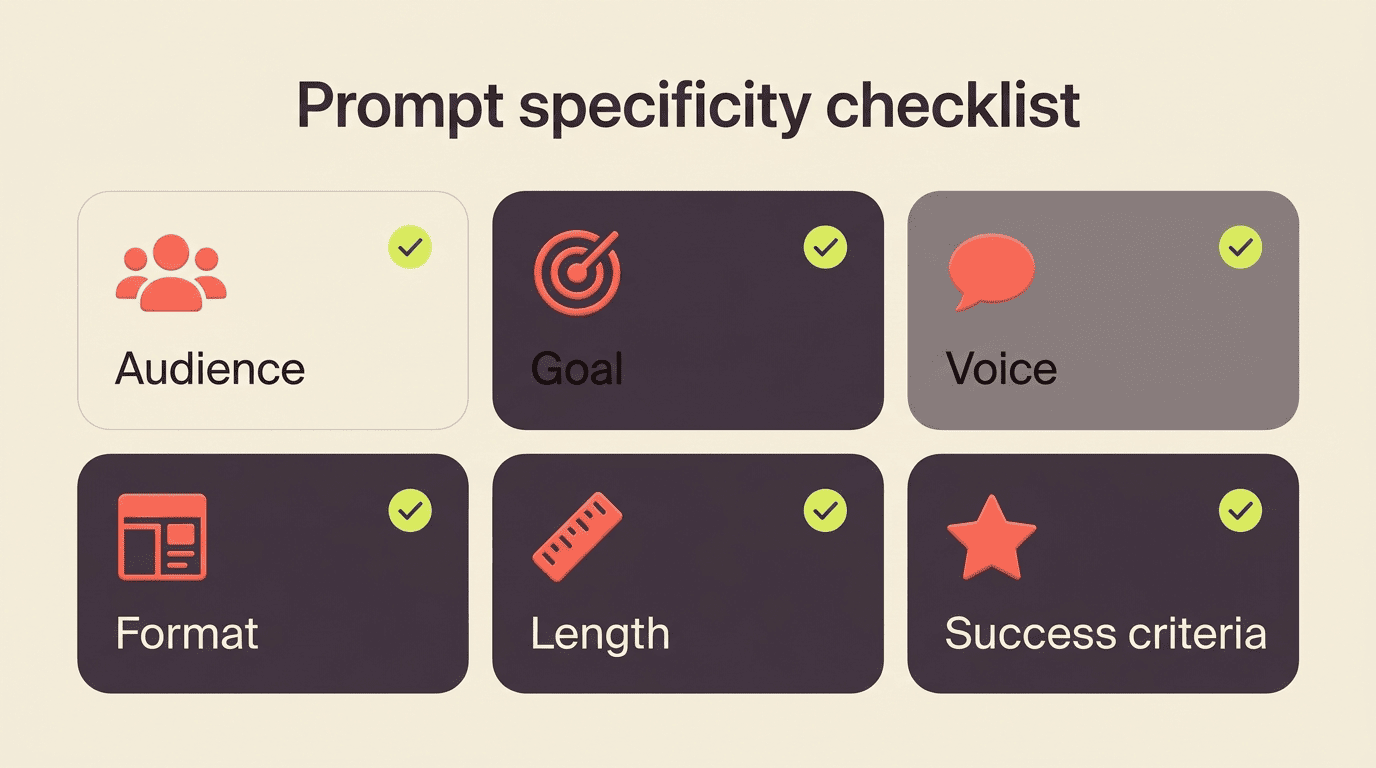
Before sending a prompt, define six things: audience, goal, voice, format, length, and success criteria. Then feed the model a content brief and a short sample of your brand voice so it has something concrete to match, rather than guessing at tone from a one-line request.
- State the target audience and what they already know.
- Name the goal — awareness, conversion, retention.
- Describe the voice with adjectives or a reference sample.
- Specify the format — blog post, ad copy, email.
- Set a length or word-count range.
- Define what «good» looks like — the success criteria.
- Attach a content brief or brand-voice snippet as reference.
Prompting is iterative
Effective prompting is rarely a single exchange. Write a prompt, review the output, refine the instructions, and re-prompt — treating the process as a short back-and-forth rather than a one-shot request.
Because the content generated from a model is non-deterministic, prompting to get your desired output is a mix of art and science.
OpenAI, Prompt Engineering Guide
A repeatable 6-step AI content workflow
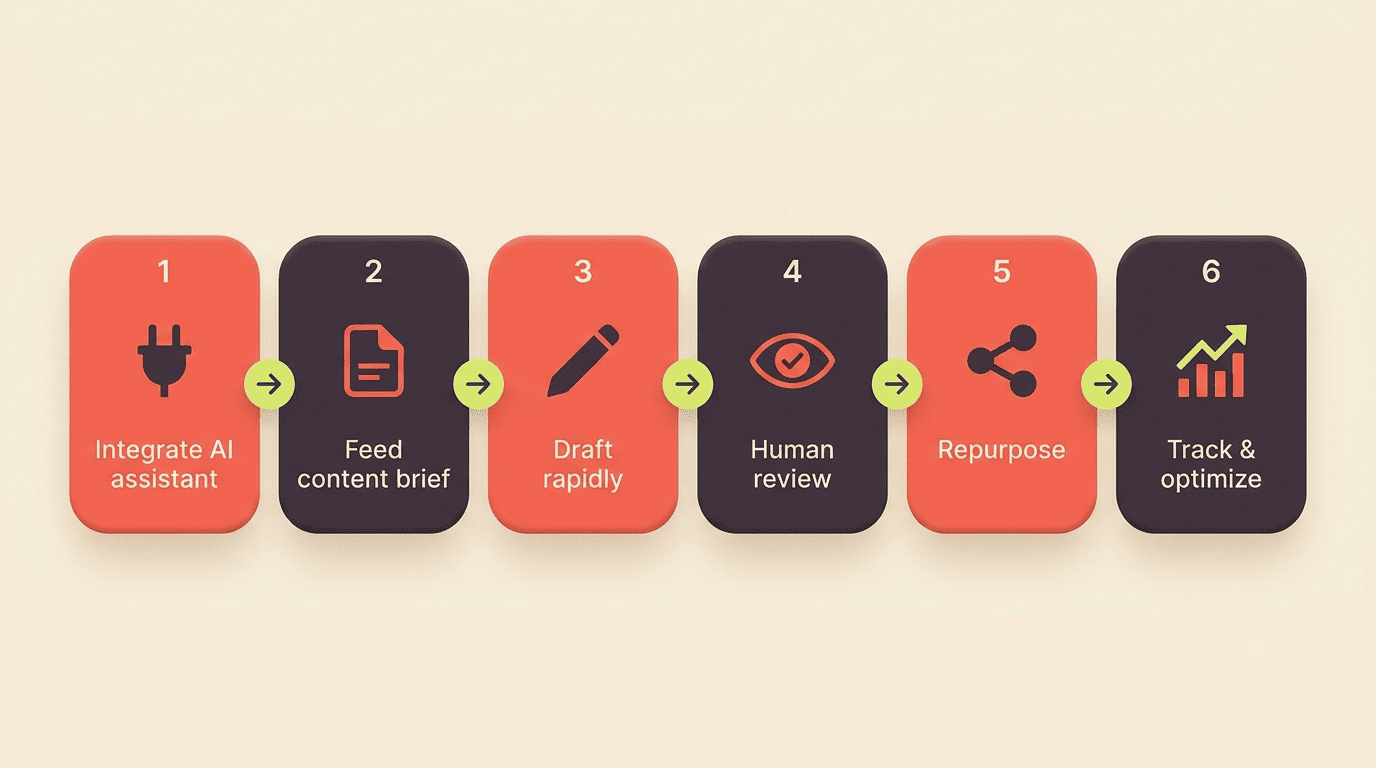
Teams that get consistent results from AI copywriting tend to run the same sequence every time rather than treating each piece as a one-off experiment. Here is a workflow that scales from a single blog post to a full content calendar.
- Integrate an AI writing assistant into the team’s existing content stack — CMS, docs, or project management tool.
- Feed detailed content briefs covering audience, goal, voice, format, and keywords for each piece.
- Draft rapidly — generate a full first draft, or several headline and angle variations, in minutes rather than hours.
- Review and fact-check every draft with a human editor before it moves forward; this gate is non-negotiable.
- Repurpose across channels — turn one long-form draft into social posts, an email, and ad copy variants.
- Track performance and optimize, feeding results back into future briefs and prompts.
Drafting that used to take hours now takes minutes, and the time saved on the first draft is what makes systematic repurposing across channels realistic for a small team. The final step closes the loop with AI marketing analytics and reporting, feeding performance data back into the next round of briefs and prompts.
Risks, quality control, and disclosure
Speed creates its own risks, and AI copywriting introduces a specific set of them: inaccurate claims, biased training data, generic output, and privacy exposure. None of these are reasons to avoid the technology, but they are reasons to build guardrails before scaling usage across a team.
The main pitfalls
The most common failure modes fall into four buckets, and each one shows up differently in a published piece of copy:
- Inaccuracy or hallucination — confident-sounding claims that are simply wrong.
- Biased or copyrighted training data — phrasing or examples that echo sources the model was trained on.
- Generic output — copy that reads the same as every competitor’s AI-assisted draft.
- Privacy leaks — sensitive data pasted into a public tool that is not built to keep it confidential.
42% of marketers cite data-privacy concerns as a reason they’ve held back from adopting AI tools, and 46% say they are only somewhat confident they would catch inaccurate AI output before it ships, according to HubSpot’s 2025 research.
Guardrails every team needs
20% of companies have no specific policy governing AI use at all, and another 30% say their organization doesn’t actively encourage AI use, according to HubSpot’s 2025 research — fixing that governance gap should come before scaling AI use further. A basic policy covers four things:
- Never enter proprietary or customer data into a public AI tool.
- Run plagiarism checks on AI-assisted drafts before they ship.
- Keep a human editorial review gate on everything before publication.
- Disclose AI use where a platform or regulator requires it.
Amazon KDP, for example, requires authors to disclose AI-generated content when publishing. The Federal Trade Commission also expects marketing claims — AI-assisted or not — to remain truthful and substantiated, and treats undisclosed or misleading AI use in advertising as subject to existing rules against deceptive practices. For background on how these models work under the hood, Wikipedia’s overview of generative artificial intelligence is a useful primer.