
AI for Marketers and SEO: Optimizing Content for Search
AI now handles most of the heavy lifting in SEO — keyword research, briefs, on-page optimization, and visibility in AI-generated answers — while marketers keep strategy and editorial judgment. Teams practicing AI for marketers increasingly treat search optimization as a workflow built around AI assistance rather than a manual, one-task-at-a-time process.

This guide covers what AI SEO actually is, how AEO and GEO fit alongside classic search rankings, the specific tasks worth handing to AI, how to optimize content for both Google and AI answers, which tools do which job, and what should always stay human.
What AI SEO is — and how AEO and GEO fit in
AI SEO means using artificial intelligence throughout the search-optimization workflow: researching keywords, analyzing SERPs, drafting briefs, checking on-page gaps, and monitoring how content performs. It has expanded the definition of «search» itself, because ranking in Google’s blue links is no longer the only surface that matters. Search behavior has shifted more in the last 18 months than in the previous decade, largely because people now get answers directly from AI systems instead of clicking through a results page.
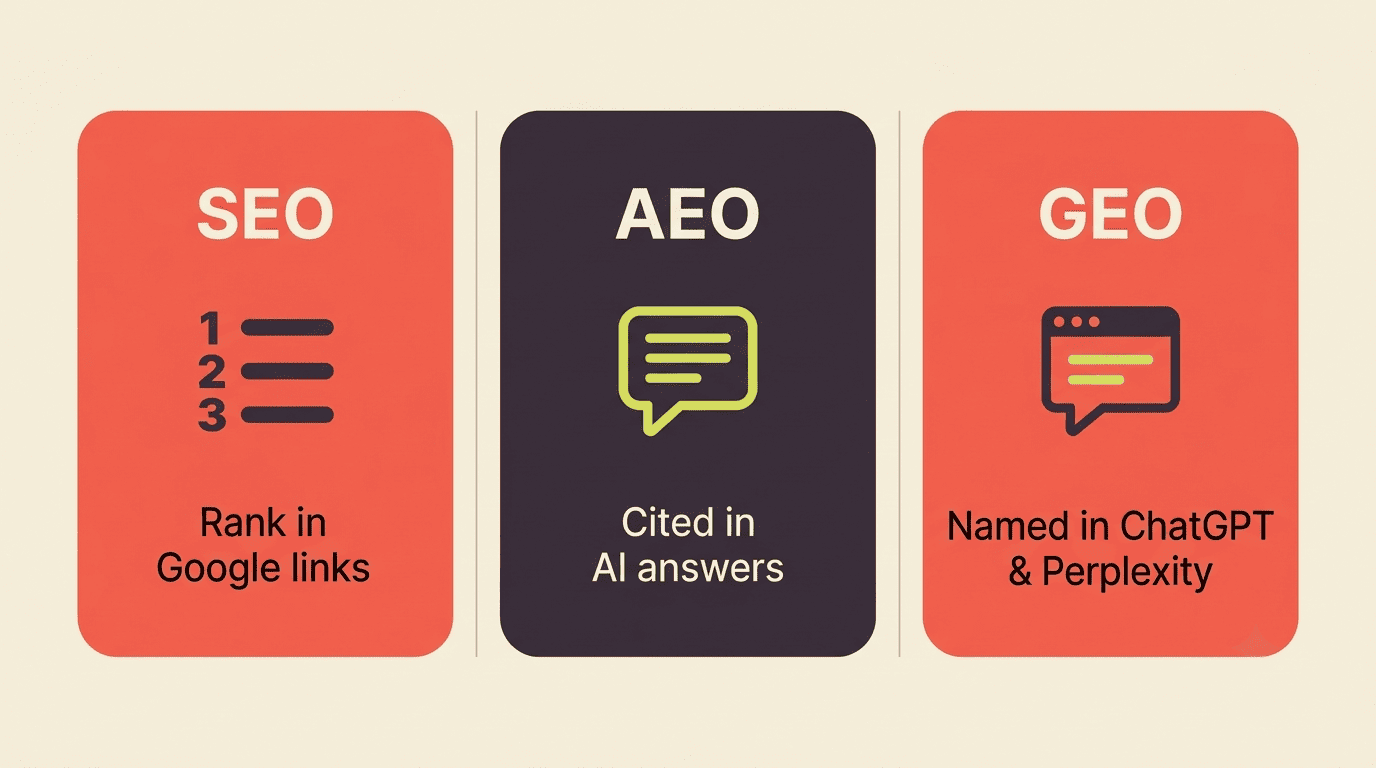
The three search battlegrounds
Classic SEO means ranking in Google’s organic results — the traditional blue-link competition. AEO, or answer engine optimization, means getting cited inside AI-generated answers and AI Overviews rather than winning a click. GEO, or generative engine optimization, means being mentioned by name inside tools like ChatGPT, Perplexity, and Gemini when someone asks a question in that interface instead of a search box. These three battlegrounds now run in parallel: AI referrals to the top 1,000 websites globally spiked 357% year-over-year in June 2025, reaching 1.13 billion visits, according to Similarweb data reported by TechCrunch — still a fraction of Google’s traffic, but enough that AI-search visibility has become a real channel, not a side experiment.
Why now
AI did not replace SEO — it expanded the surface a marketer has to optimize for. A page that ranks well in Google but is never cited in an AI answer is now only half-optimized, and the reverse is also true. Google’s own guidance on creating helpful, reliable, people-first content still governs both surfaces, because AI answer engines and traditional ranking systems reward largely the same qualities: clarity, accuracy, and demonstrated expertise.
Where AI helps across the SEO workflow
AI has already become embedded in specific, repeatable tasks rather than replacing the SEO process wholesale. The gap between «AI helps me research» and «AI writes my articles» is wide, and understanding where marketers actually draw that line matters more than any single tool choice.
The tasks marketers already delegate to AI
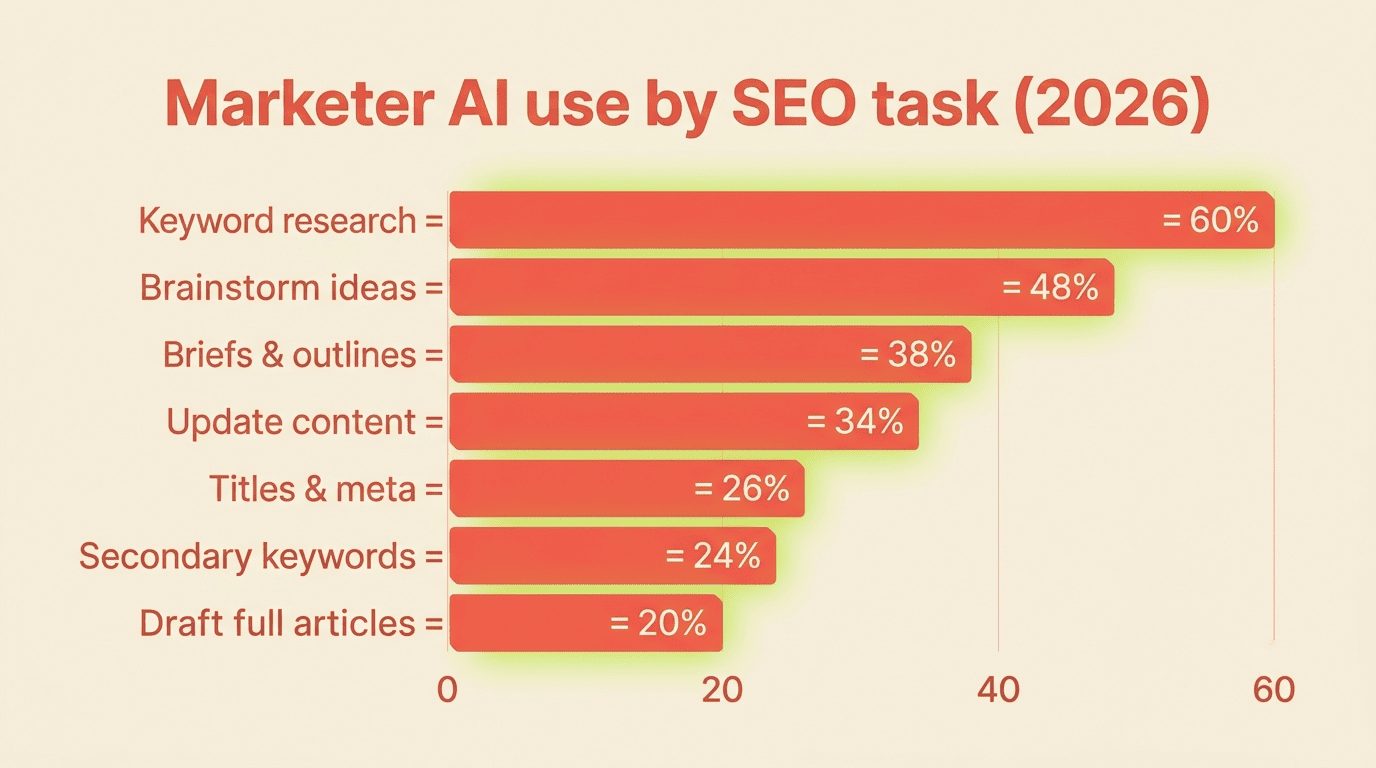
According to a Semrush survey of 100 B2B and B2C marketers from early 2026, adoption clusters heavily around research and planning rather than final drafting:
| Task | Share of marketers using AI |
|---|---|
| Keyword research | 60% |
| Brainstorming content ideas | 48% |
| Writing briefs and outlines | 38% |
| Updating existing content | 34% |
| Titles and meta descriptions | 26% |
| Finding secondary keywords | 24% |
| Drafting full SEO articles | ~20% |
Notice the pattern: keyword research, ideation, and briefs dominate, while only about one in five marketers use AI to draft complete articles. AI functions mainly as a research and planning assistant, not as the primary writer — the final content still runs through a human pass in the large majority of cases. The same research-first, human-edited pattern carries over to adjacent channels such as AI email marketing, where AI drafts and a person still owns the send.
A repeatable AI SEO workflow
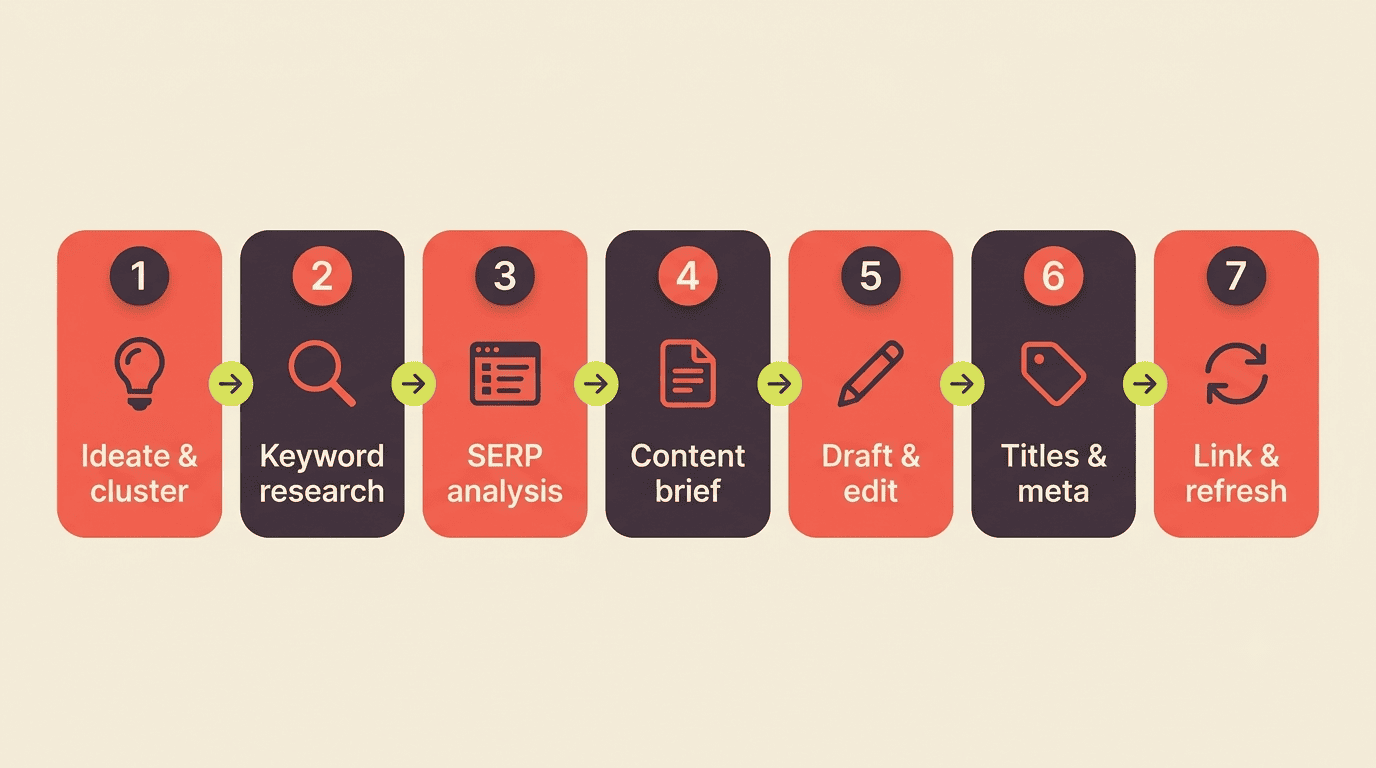
Build a sequence, not a pile of one-off prompts. A workflow that repeats produces consistent quality; a workflow reinvented for every article produces uneven results and wastes the time AI is supposed to save. Here is a workflow marketers can run for any content piece:
- Ideate topics and group them into clusters around a core theme.
- Run keyword research to size demand and identify variants.
- Analyze the current SERP to see what’s already ranking and why.
- Build a content brief covering intent, entities, and structure.
- Draft with AI assistance, then edit for accuracy and voice.
- Finalize titles and meta descriptions — titles under 60 characters, meta descriptions in the 105–160 character range.
- Add internal links to related content and refresh the piece on a schedule.
Running this same sequence every time is what turns AI from a novelty into a dependable part of the SEO process.
How to optimize content for search and AI answers
Optimizing for Google’s ranking algorithm and optimizing for AI answer engines overlap more than they diverge, but each surface has its own mechanics worth handling separately. Optimization increasingly overlaps with personalization at scale, too, since AI can tailor which page or answer each visitor lands on.
Structure content into parseable, snippable units
Align the title, H1, and meta description around the same core query so search engines and AI systems read a single, consistent signal about what the page covers. Keep individual sentences self-contained — a sentence that only makes sense with three sentences of prior context is hard for an AI answer engine to lift cleanly. A handful of structural choices make content noticeably easier for AI systems to extract and cite:
- Clear H2 and H3 headings written as distinct «content-slice» chapters, each one answerable on its own.
- Question-and-answer formats that mirror how people actually phrase queries.
- Bulleted lists and comparison tables instead of dense paragraphs for anything list-shaped.
- JSON-LD structured data from schema.org, so search engines and AI crawlers get an explicit label for what type of content a page contains.
On-page optimization AI does well
AI tools are strong at finding on-page gaps compared with top-ranking pages, optimizing titles and meta descriptions, clustering related queries into a single page, surfacing internal-linking opportunities, analyzing search intent, and flagging readability issues. Beyond structure, a few crawl-level details matter for AI visibility specifically:
- Add authoritative references and original data where relevant.
- Allow both the standard Googlebot and the Google-Extended crawler in robots.txt, so content is eligible for both classic indexing and AI training/citation.
- Refresh content on a regular cadence — AI search systems tend to favor recently updated pages when multiple sources say roughly the same thing.
The best AI SEO tools
Picking the right tool depends on the task — general-purpose AI assistants and SEO-specific platforms solve different parts of the workflow, and most teams end up using both.
General AI vs SEO-specific platforms
General-purpose assistants — ChatGPT, Gemini, and Perplexity — are well suited to ideation, brief-writing, and topic clustering, because they handle open-ended reasoning and can hold a lot of context about a brand or campaign at once. SEO-specific platforms such as Semrush, Surfer SEO, Clearscope, and Frase focus narrowly on optimization scoring and SERP-based briefs, comparing a draft against what is already ranking for a given query. Google Search Console rounds out the stack by supplying the real performance data — impressions, clicks, and average position — that no AI tool can generate on its own, since it reflects actual user behavior rather than a prediction.
| Tool | Best for |
|---|---|
| ChatGPT / Gemini | Ideation, briefs, open-ended research |
| Perplexity | Fast research with cited sources |
| Semrush | Keyword research, SERP analysis, content audits |
| Surfer SEO | On-page optimization scoring against top results |
| Clearscope | Content grading and topical coverage |
| Frase | SERP-based brief generation |
| Google Search Console | Real click, impression, and ranking data |
Most of these platforms take roughly two to four weeks to learn well enough to use efficiently, so budgeting onboarding time is worth doing before committing a whole team to one tool.
What to automate vs what to keep human
The line between what AI should own outright and what a person needs to review is the single most important operational decision in an AI SEO workflow.
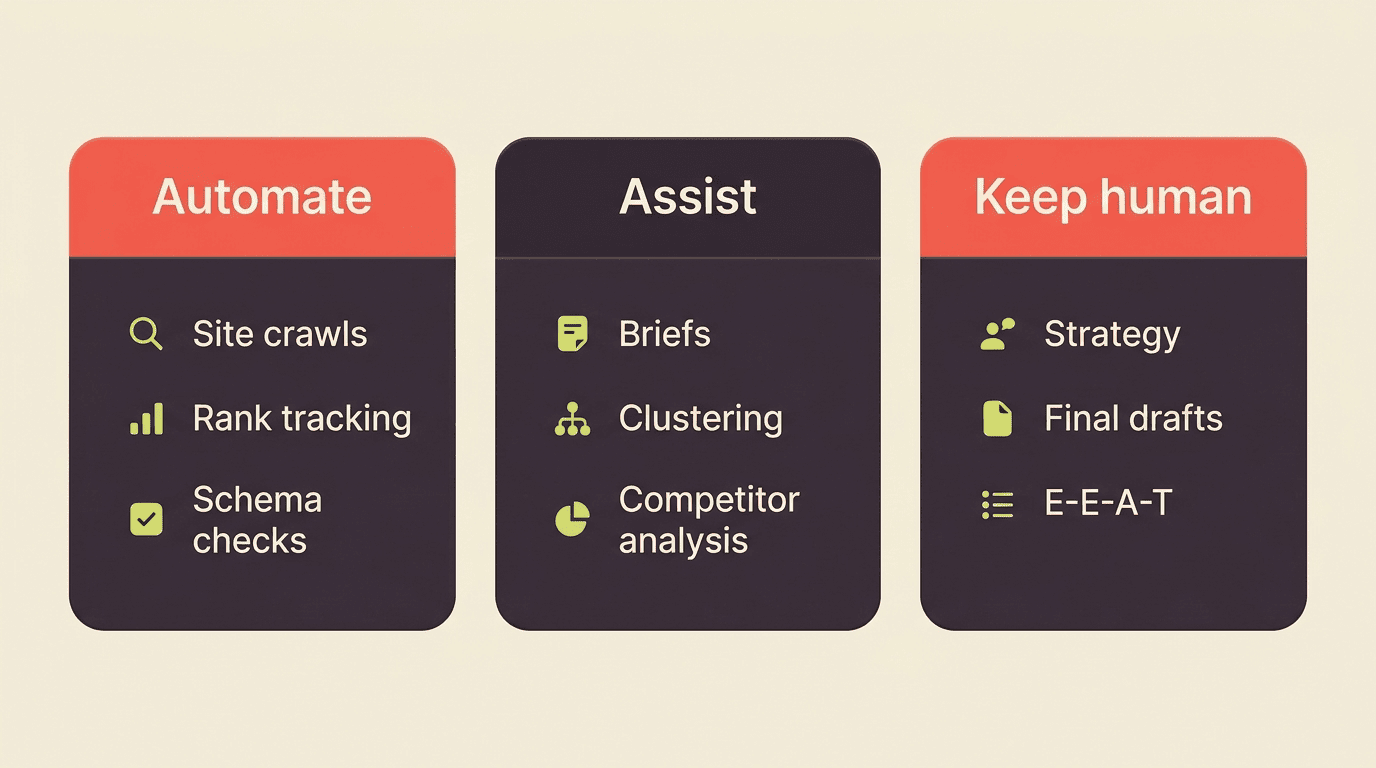
The Automate / Assist / Keep-human split
Automate the repetitive, verifiable tasks. Site crawls, rank tracking, schema validation, and broken-link checks all have a clear right answer, so there is little risk in letting AI run them unsupervised.
Assist — but keep a human reviewing — anything judgment-based. Briefs, topic clustering, and competitor analysis benefit from AI speed, but a person should sanity-check the output before it shapes a content calendar.
Keep strategy, positioning, final drafts, and E-E-A-T fully human. These are the parts of SEO where AI output tends to sound generic or miss context that only comes from firsthand experience with a brand, product, or audience.
The payoff for getting this split right is measurable: HubSpot’s AI Trends survey of 1,000+ marketing professionals found most say AI is highly effective for content creation and research, saving an average of one to two hours in their workday — time that goes back into the strategic work AI cannot do.
Using automation, including AI, to generate content with the primary purpose of manipulating ranking in search results is a violation of our spam policies.
Google Search Central
That guidance is the practical version of «use AI for volume, humans for judgment» — the rule is not about whether AI touched a draft, but whether the finished page is genuinely useful to a person who reads it.
E-E-A-T and the risk of generic AI content
Google evaluates content against Experience, Expertise, Authoritativeness, and Trustworthiness — collectively known as E-E-A-T, a framework that has become central to how modern search quality raters assess pages. Strengthening those signals means adding original research, firsthand experience, proprietary data, and a visible expert perspective — none of which an AI model can manufacture on its own. The main risks of skipping that step are hallucination (confident but incorrect claims), generic copy that reads like every competitor’s AI-assisted draft, and exposure on YMYL topics, where inaccurate advice can cause real harm. The safeguard is consistent regardless of topic: fact-check every AI-assisted claim and never publish AI output unedited.