
AI for Marketers: Email Marketing and Campaigns
Email teams that are using AI in marketing can now ship in a day what used to take two weeks. AI writes, personalizes, times, and analyzes email campaigns, and nearly half of marketers already use it in some form.

This guide covers what AI email marketing actually is, which campaign tasks are worth delegating to it, how to write and personalize with AI without losing your brand voice, the tools marketers reach for most, and the data, consent, and quality guardrails that keep automated sends trustworthy.
What AI email marketing is — generative vs predictive
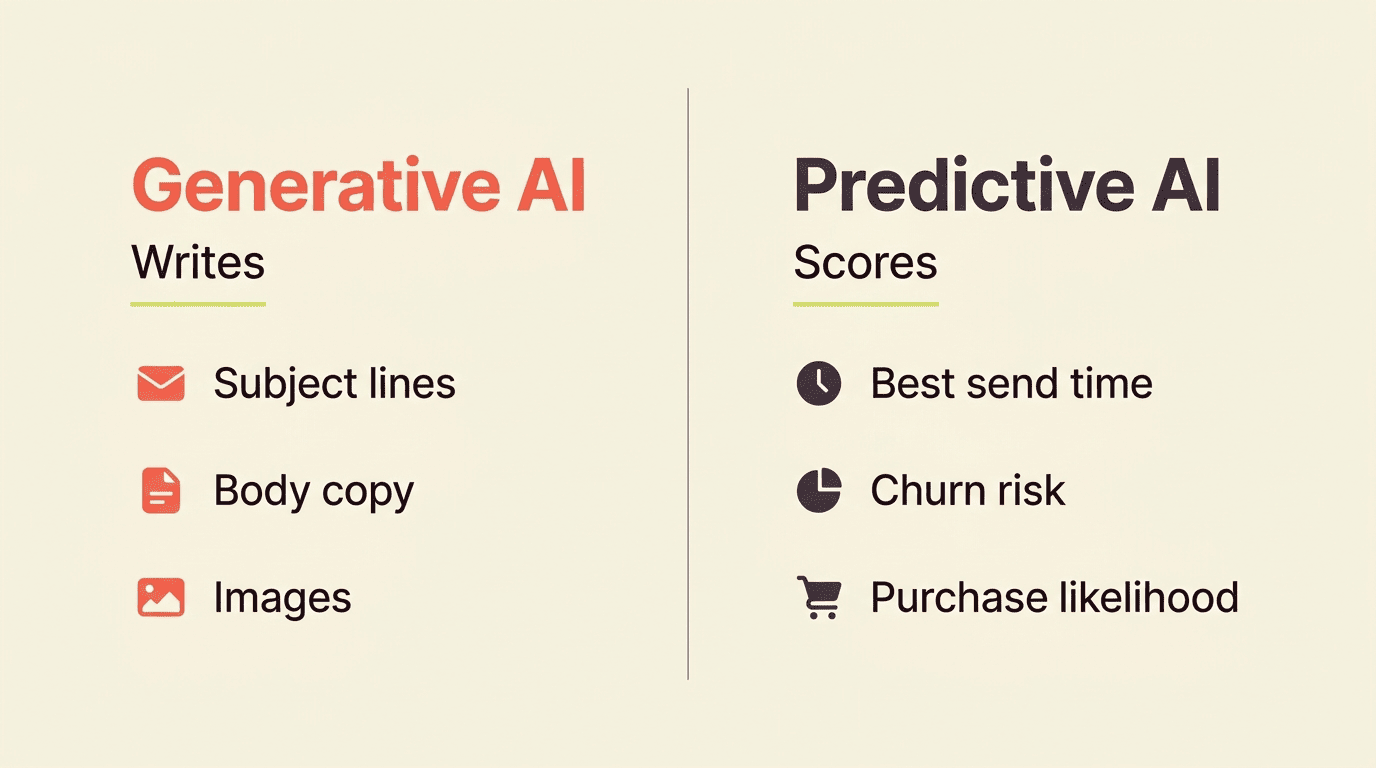
Two different technologies get lumped together under «AI email marketing,» and confusing them is the fastest way to pick the wrong tool for the job. Generative AI writes: subject lines, body copy, and images. Predictive AI scores: it looks at behavioral data and estimates best send time, churn risk, or purchase likelihood. AI personalizes email at scale precisely because it combines both — generating the message and predicting who should get which version, when. Most modern email platforms blend the two rather than offering just one.
Two kinds of AI doing two different jobs
Generative AI drafts subject lines, body copy, and creative assets on request, working from a prompt the way a copywriter would work from a brief. Predictive AI instead mines historical opens, clicks, and purchases to forecast an individual subscriber’s best send time, likelihood to churn, or propensity to buy. Nearly half of email marketers already use AI in their workflow, and another quarter plan to start, according to Forbes Advisor research. The two systems are complementary: predictive AI decides who and when, generative AI decides what to say.
Why adoption is accelerating
Adoption is not a slow creep — it’s a jump. Roughly 70% of email marketers expect up to half of their email operations to be AI-driven by the end of 2026, and marketers report content demand roughly doubling as generative AI absorbs more of the drafting and image-generation workload. That pace mirrors broader consumer email marketing trends, where entire teams have reorganized their production calendars around AI-assisted drafts rather than fully manual ones. The same drafting speed powers AI for social media marketing, where one asset gets spun into a week of platform-specific posts.
Where AI helps across an email campaign
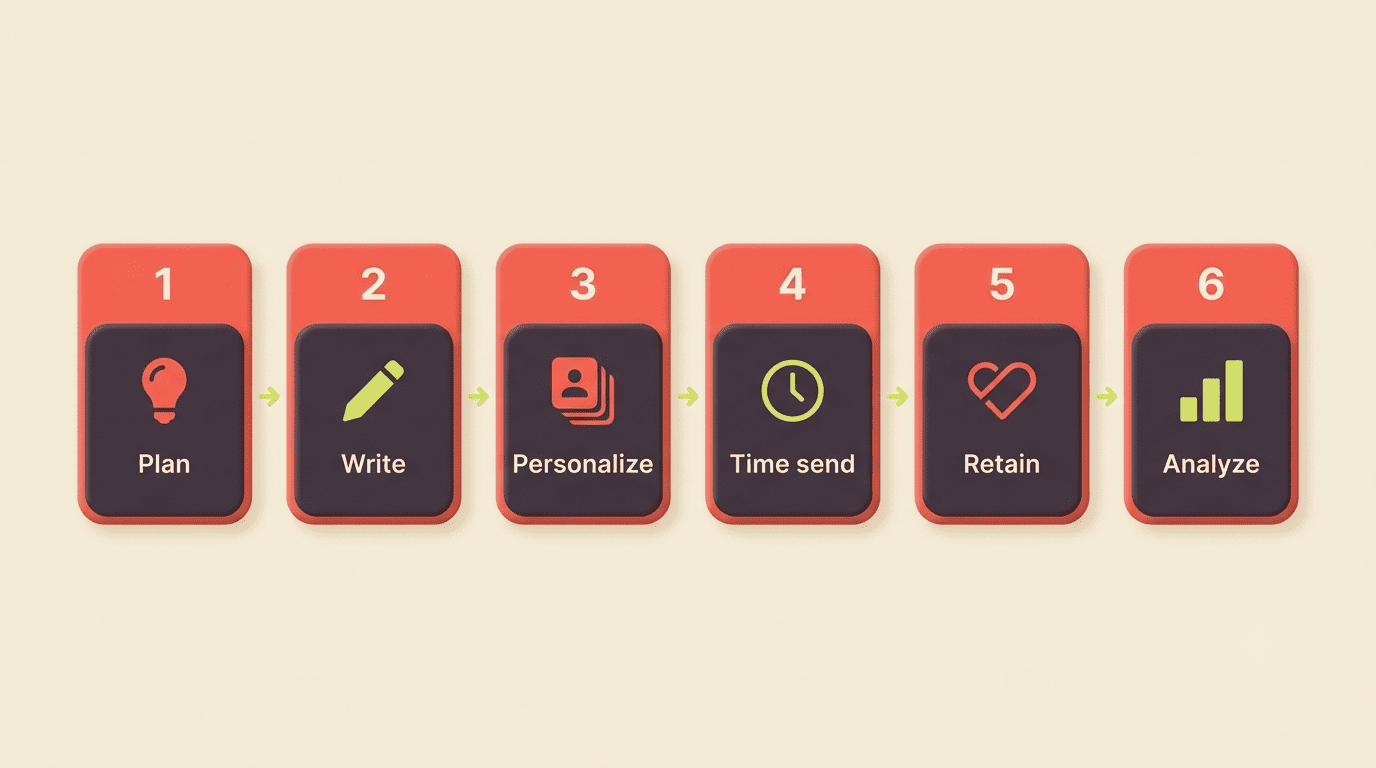
AI optimizes send time and touches nearly every stage of a campaign, not just the writing. It shows up in ideation, subject-line testing, segmentation, dynamic content, churn prevention, and post-send analysis — often as several small automations stacked together rather than one big tool doing everything.
The core use cases
AI’s footprint across a campaign typically includes:
- Ideation and campaign planning — generating angles, themes, and calendar suggestions
- Subject-line generation and A/B testing at a scale no human team could run manually
- Body copy drafting for first drafts, variant testing, and localization
- Hyper-personalization and dynamic content blocks that swap per subscriber
- Send-time and frequency optimization based on individual engagement patterns
- Predictive segmentation and churn re-engagement targeting
- Image and creative generation for headers and product shots
- Post-send performance analysis and anomaly flagging
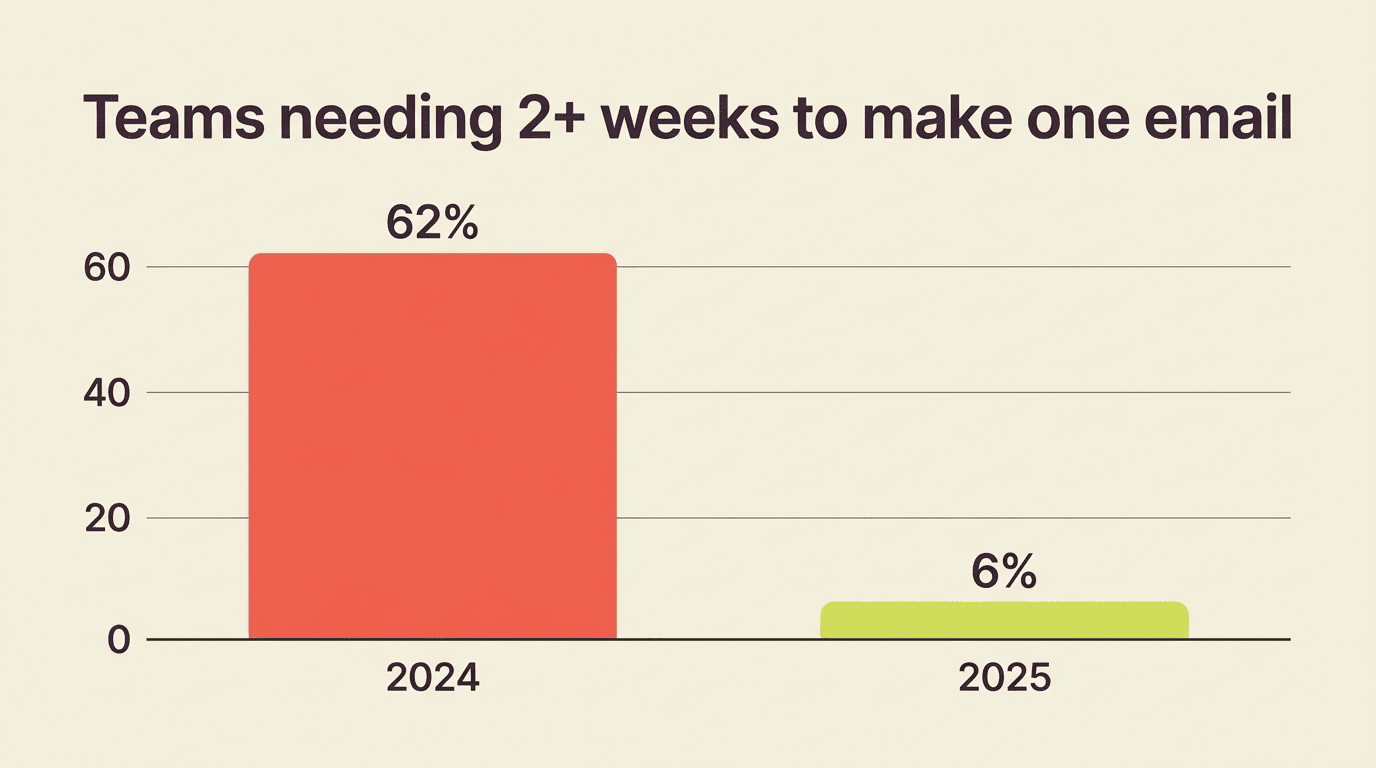
The production-speed shift is the most measurable part of this. In 2024, 62% of email teams needed two weeks or more to produce a single campaign email; by 2025, only 6% did. Tasks that took half a day now take minutes for a first draft.
| Campaign stage | AI task | Typical output |
|---|---|---|
| Planning | Ideation, angle generation | Campaign themes, content calendar |
| Writing | Subject line and copy drafting | First-draft variants for A/B tests |
| Personalization | Dynamic content, segmentation | Per-subscriber blocks, audience cohorts |
| Timing | Send-time optimization | Individual best-send-time predictions |
| Retention | Churn prediction | Re-engagement trigger lists |
| Analysis | Performance review | Open/click anomaly flags, next-test suggestions |
Personalization and timing are where AI shines
This is the use case with the clearest return: AI tailors content, product recommendations, and send times per subscriber by reading first-party data rather than applying one rule to an entire list. Individual-level send-time prediction and dynamic content blocks lift engagement without requiring a marketer to manually build a variant for every segment — the system builds thousands of micro-segments a human team never could. That segment-building is the same engine behind AI audience segmentation across every channel, not just email.
How to write and personalize emails with AI
Good AI-assisted copy starts with a specific prompt, not a vague one. The clearer the brief, the less editing a human has to do afterward — and editing is still the step that keeps the email on-brand.
Prompt by lifecycle stage
Specify the stage before you ask for copy. A welcome email, a nurture email, a sales-acceleration email, and a renewal email all need different tone, length, and CTA — feeding the AI the recipient’s lifecycle stage, segment, and desired outcome produces a far more usable draft than a generic «write me a marketing email.» Pair that with modular content blocks: pre-approved paragraph, image, and CTA components that a human curates and assembles rather than freeform AI text dropped straight into a send.
Keep the brand voice — AI is a first draft
AI can produce copy that reads as grammatically correct but forgettable — technically fine, tonally flat. Generative AI drafts subject lines and copy quickly, but every output should be treated as a starting point, not a finished asset: edit for brand voice, fact-check for hallucinated claims or statistics, and never send anything unedited to a live list.
If you understand that AI is your first-draft engine and not your strategist, you will use it correctly.
Lilach Bullock, AI Implementation Consultant
That framing — treating AI output the way an editor treats a junior writer’s draft — is the single habit that separates teams getting real lift from AI email tools and teams getting bland, interchangeable copy.
The best AI email marketing tools
Tool choice usually splits along one line: general-purpose AI writers versus email-native platforms with built-in AI. Most marketing teams end up using at least one from each category rather than picking a single winner.
General AI vs email-native platforms
General-purpose writers dominate early drafting — ChatGPT is the most commonly used model for content creation, alongside Claude, Copy.ai, and Jasper for text, and DALL-E or Canva for images; over half of marketers now use AI tools to optimize campaign content. Email-native platforms bake AI directly into the send workflow, and specialists fill narrower niches within it:
- Mailchimp and MailerLite — AI subject-line and content suggestions built into the campaign editor
- Twilio SendGrid — delivery infrastructure at a scale of well over 100 billion emails per month, with AI-assisted deliverability tooling layered on top
- Phrasee — AI-generated marketing language, tuned per brand voice
- Seventh Sense — individual-level send-time optimization
- Persado — enterprise-grade generative language testing
| Tool | Best for | Rough price range |
|---|---|---|
| ChatGPT / Claude | General copy drafting, brainstorming | Free–$20/month |
| Mailchimp / MailerLite | All-in-one campaign build + send | ~$12–$350/month |
| Twilio SendGrid | High-volume transactional + marketing delivery | Usage-based, enterprise tiers |
| Phrasee | AI-generated marketing language | Enterprise pricing |
| Seventh Sense | Individual send-time optimization | Enterprise pricing |
| Persado | Generative language at enterprise scale | Custom enterprise pricing, often six figures/year |
Pricing spans a wide range — from roughly $12 a month for a small-list email platform with built-in AI features to custom, often six-figure annual contracts for enterprise generative-language platforms like Persado. Most mid-size teams start with a general AI writer plus their existing email service provider’s built-in AI features before adding a specialist tool.
Data, consent, deliverability, and disclosure
AI email requires first-party data and consent before it requires a better prompt. Speed without governance is how a marketing team ends up with a deliverability problem or a compliance complaint, not a better campaign.
Good data and valid consent come first
AI needs clean first-party and CRM data plus valid opt-in consent to personalize responsibly — feeding it stale or improperly sourced contact data just personalizes bad outreach faster. Review opt-ins and compliance status before scaling any AI-driven send: in the United States, that means following the CAN-SPAM Act enforced by the FTC; in the EU, it means honoring GDPR consent requirements. AI’s speed is exactly what creates unsolicited-mail exposure if governance and data quality don’t come first — automation makes it easy to blast a list that was never properly opted in.
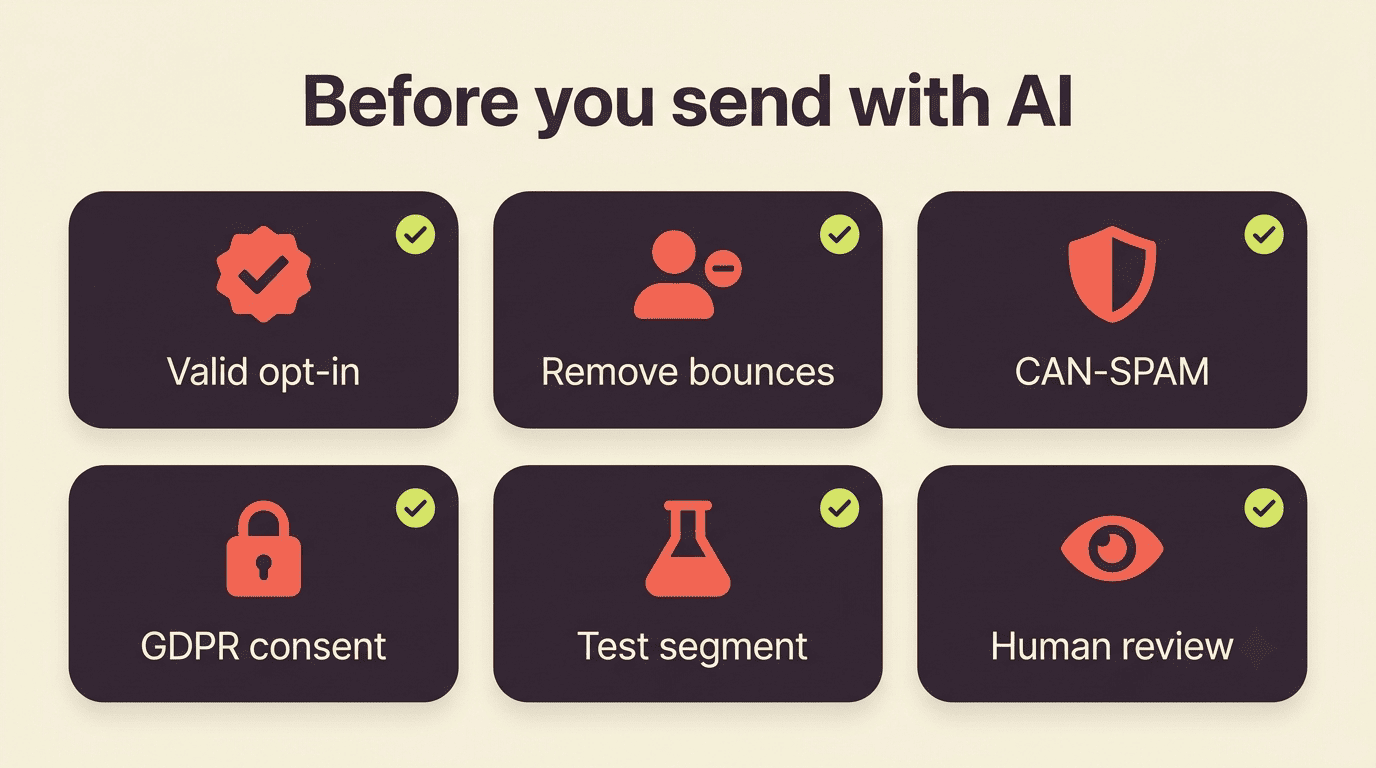
Here’s a short sequence for checking a list before turning AI-driven sends loose on it:
- Confirm every contact has a documented, valid opt-in record.
- Segment out anyone who unsubscribed or bounced previously.
- Verify CAN-SPAM requirements are met — physical address, working unsubscribe link, accurate header information.
- Check GDPR consent basis for any EU-based subscribers.
- Run a small AI-generated test send to a control segment first.
- Review AI output for brand-voice and factual accuracy before the full send.
- Monitor deliverability metrics (bounce rate, spam complaints) after the send.
Trust and transparency
Consumer skepticism is a real constraint, not a hypothetical one: roughly two in five consumers say they are less likely to trust a marketing email they know was written by AI. That argues for disclosing AI use where appropriate, monitoring outputs for bias, and keeping personalization strictly within the scope of consent a subscriber actually granted — not stretching a «welcome series» opt-in into unrelated promotional sends. According to the Wikipedia entry on email marketing, deliverability and recipient trust have been central concerns of the discipline since long before AI entered the picture — automation raises the stakes on both.
A practical safeguard is a two-stage QA pass before any AI-assisted campaign goes out:
- Clarity and accuracy check — does the copy read naturally, and are any facts, numbers, or claims verifiable?
- Compliance check — does the send respect CAN-SPAM, GDPR, and the specific consent scope the subscriber granted?