
AI for Marketers: Social Media Management and Content, Done Faster
Social teams have quietly rebuilt their entire day around artificial intelligence. An AI marketing assistant now touches every stage of the job — ideation, drafting, scheduling, listening, and reporting — instead of one isolated task.

The payoff is measurable. Across the industry, 72% of surveyed social media marketers report that AI-created social content performs better than content made without it, and roughly 96% of social managers already use generative AI tools in some form. The teams pulling ahead treat AI as an assistant, not an autopilot.
How AI Changed the Social Media Manager’s Day
The shift is not about a single magic button. AI has spread across the full content pipeline, quietly removing friction at each step: ideate, create, schedule, listen, and analyze. What used to take a specialist and a spreadsheet now happens inside the tools marketers already open every morning.
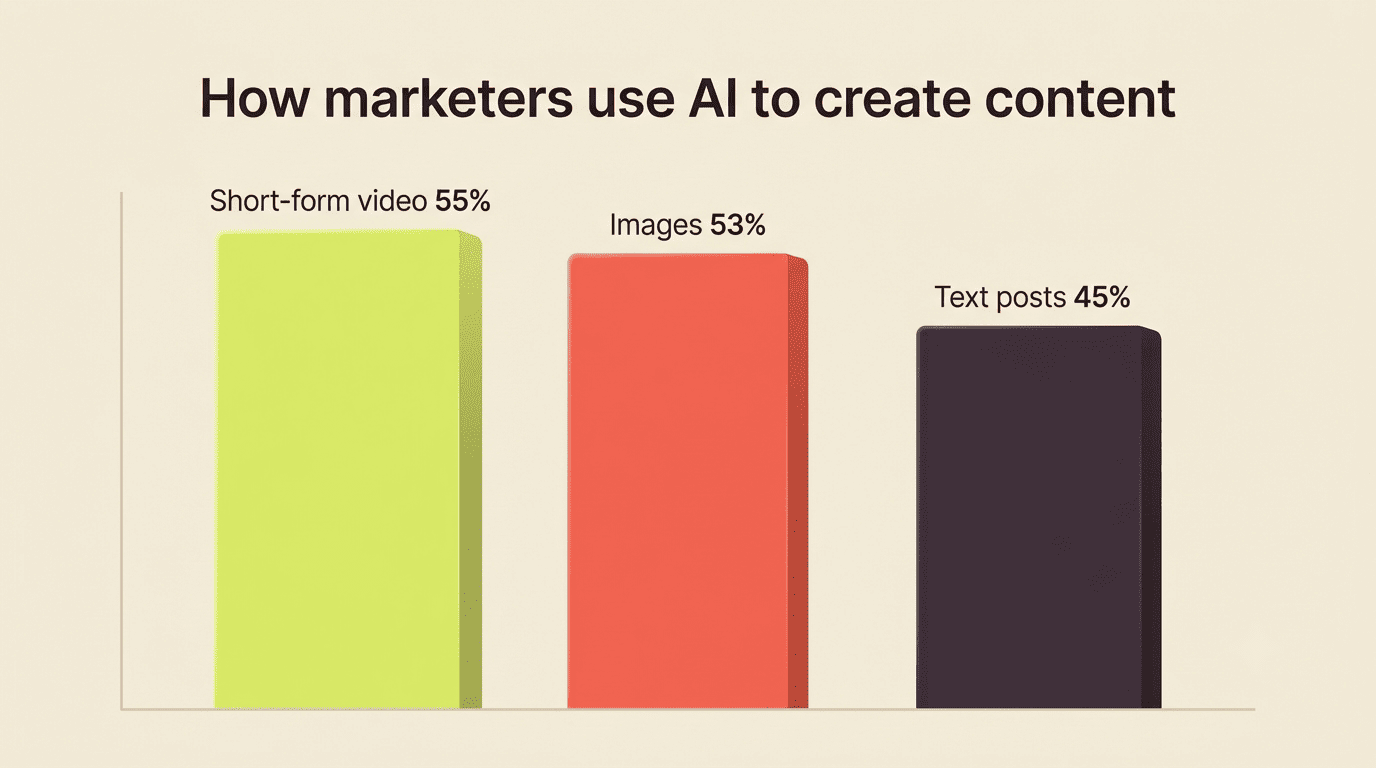
Adoption is broadest in production. Recent industry survey data shows 55% of marketers use AI to create short-form video, 53% use it for images, and 45% use it for text posts. The most common tools split cleanly into three buckets: 53% use visual generators such as DALL-E and Midjourney, 51% use AI chatbots such as ChatGPT and Claude, and 49% use embedded AI assistants such as Microsoft Copilot and Google Gemini.
Where AI actually plugs into the workflow
Think of the social workflow as five connected stages, each with a natural place for AI. In ideation, models surface angles and hooks from a brief. In creation, they draft captions, generate visuals, and cut short-form video. In scheduling, they predict when an audience is most likely to engage. In listening, they read sentiment across thousands of mentions. In analysis, they turn raw metrics into a plain-English recommendation.
Because these stages feed each other, gains compound. A sharper listening signal produces a better content brief, which produces a stronger post, which produces cleaner analytics — and the loop tightens with every cycle. That is why marketers with AI tools for marketers embedded across the pipeline report more output without a proportional jump in headcount.
The assistant vs. autopilot line
There is a clear line between using AI well and using it badly, and audiences can feel it. Buffer frames the rule simply: AI handles the how, but you still own the what and why. The model can produce ten caption variants in seconds; deciding which one sounds like your brand is still a human job.
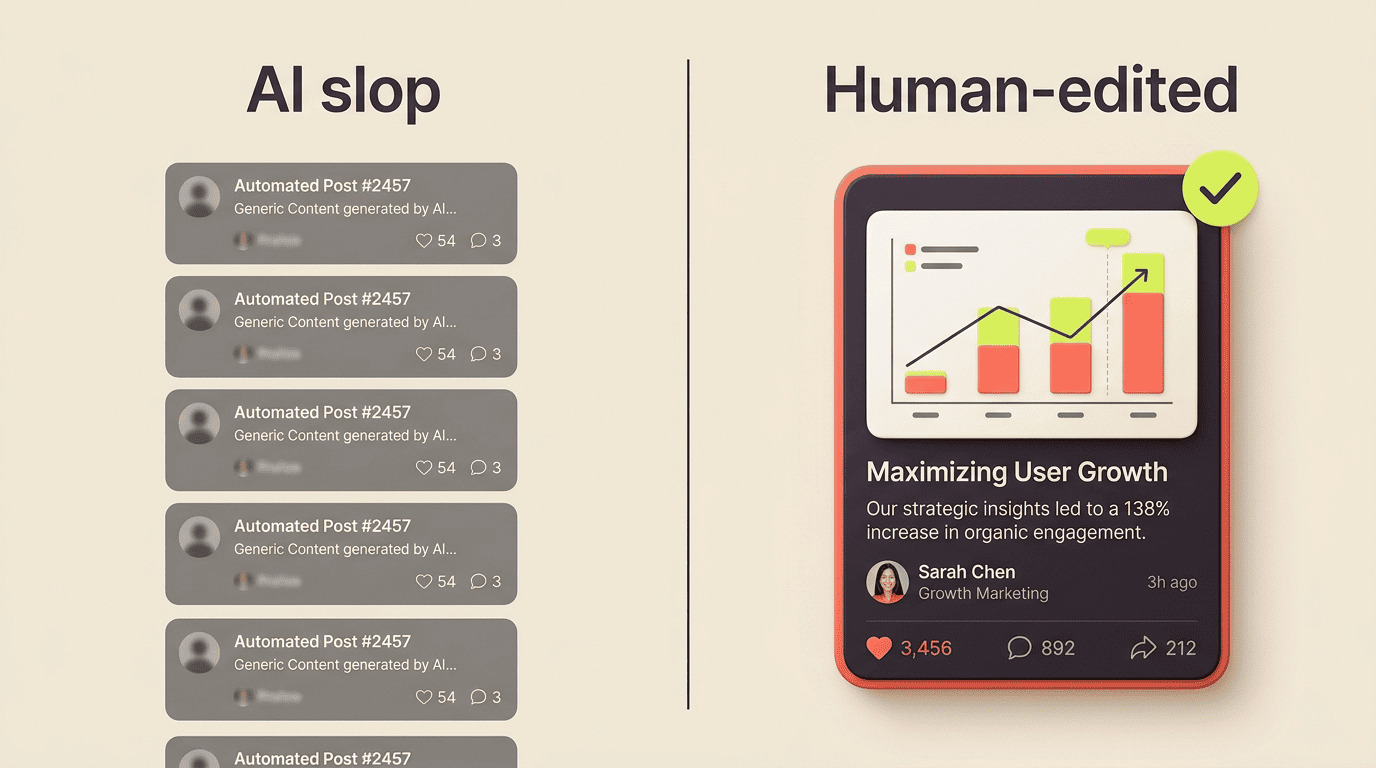
Skip that judgment and the audience punishes you. Roughly 56% of social users say they often encounter «AI slop» — mass-produced, low-effort AI content — and younger users are the most likely to mute or unfollow accounts that feel machine-made. Human review is not a nice-to-have; it is the guardrail that keeps AI-assisted output from reading as generic.
Content is fire; social media is gasoline.
Jay Baer
Creating and Repurposing Content with AI
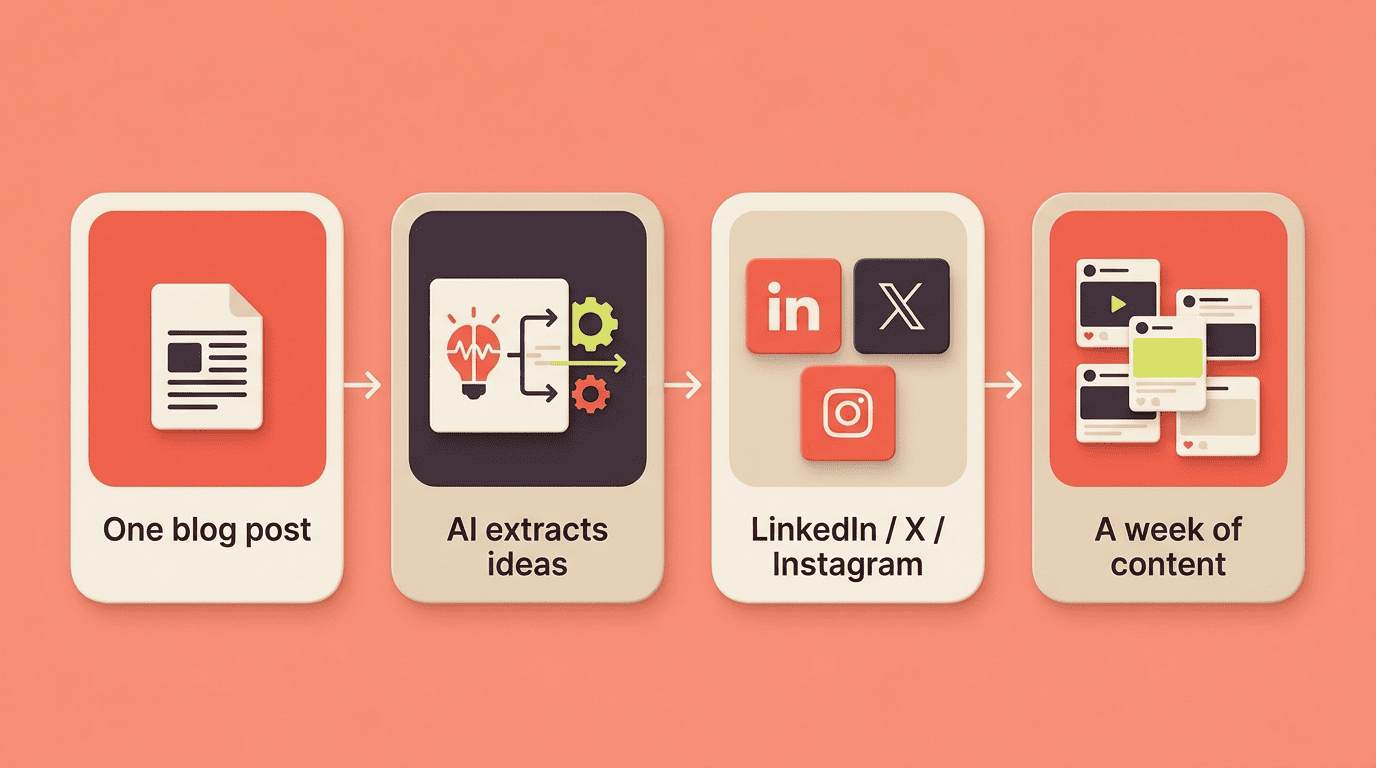
Content creation is where marketing with AI delivers its fastest, most visible wins. The single biggest lever is repurposing: instead of writing each post from scratch, you feed the model one substantial asset — a blog post, a webinar recording, a podcast episode — and ask it to spin platform-specific variants. One piece of pillar content becomes a LinkedIn post, an X thread, an Instagram caption, and a short video script in one sitting.
A practical AI content stack is also cheap relative to the output. Buffer estimates that a working set of AI content tools runs roughly $50-100 per month, and more than 200,000 creators, small businesses, and marketers already build on that kind of stack.
From one idea to a week of posts
The repurposing pattern follows a simple sequence that any marketer can run:
- Pick one high-value source asset (a blog, webinar, or customer interview).
- Ask the model to extract 5-10 key ideas or quotes.
- Generate platform-specific drafts for each network, with the right length and tone.
- Request hook variations and hashtag sets for the top posts.
- Edit every draft for voice, accuracy, and a human point of view before scheduling.
That last step is non-negotiable. The AI marketing assistant gets you to a strong first draft in minutes, but the edit is what separates a post that converts from one that reads like filler.
Visuals, short-form video, and captions
Production is no longer bottlenecked by design or editing skills. For visuals, generative tools such as DALL-E, Midjourney, Canva, and Adobe Firefly create on-brand graphics from a text prompt. For video, editors such as CapCut generate auto-captions in more than 130 languages, while tools like OpusClip extract short clips from long recordings and Descript edits audio and video by editing the transcript.
Reach scales with language, too. Platforms such as Ocoya generate content in 26 languages, which lets a lean team localize a campaign that once required agencies in every market. The table below maps common jobs to the type of AI tool that handles them.
| Content job | AI tool type | Examples |
|---|---|---|
| Captions and copy | Text/chat model | ChatGPT, Claude, Jasper, Copy.ai |
| Images and graphics | Image generator | DALL-E, Midjourney, Canva, Firefly |
| Short-form video | Video editor | CapCut, OpusClip, Descript |
| Repurposing | Assistant + automation | Buffer AI Assistant, Zapier |
Scheduling, Timing, and Optimization
Making good content is only half the job; publishing it at the right moment is the other half. AI turns posting time from guesswork into prediction, reading historical engagement patterns to recommend when a specific audience is most active.
Timing is one part of a larger optimization story. Personalization — tailoring content and offers to segments rather than the whole list — is now table stakes: 93% of marketers say personalization improves leads or purchases. AI is what makes that personalization affordable at social-media scale. The same optimization discipline extends to AI for paid ads and campaign optimization, where budget shifts automatically toward whatever is converting.
Predicting the best time to post
Most major platforms now ship send-time prediction. Sprout Social’s ViralPost feature, along with scheduling suggestions in Buffer and Hootsuite, analyzes audience behavior to surface optimal posting windows per network. Instead of copying a generic «best time to post» chart, you get windows calibrated to your own followers.
The value grows with volume. A brand posting five times a day across four networks makes twenty timing decisions daily; automating them frees the team to focus on the message rather than the calendar. Over a quarter, better timing quietly lifts reach without a single extra post.
Reacting fast: comments, DMs, and care
Speed matters after publishing, too. AI-powered smart inboxes triage incoming comments and messages, flag the urgent ones, and draft replies for a human to approve. This closes the gap between a customer’s question and your answer. For always-on conversations, many teams pair this with AI chatbots for customer engagement that respond instantly around the clock.
That gap is worth closing. Sprout Social’s research found that 76% of consumers appreciate brands that prioritize customer support on social, and nearly three-quarters expect a response within 24 hours. AI drafts the reply in seconds; a person still decides whether to send it.
Social Listening and Sentiment Analysis
Before you create anything, AI can tell you what your audience already feels. Social listening tools scan millions of public conversations, and sentiment analysis models classify them as positive, negative, or neutral — even across slang, regional vernacular, and misspellings that keyword tools miss.
The scale involved is hard to overstate. Sprout Social alone processes 600 million messages a day, using named entity recognition to filter noise and sentiment mining to track brand health in near real time. At that volume, the bottleneck is no longer gathering data — it is interpreting it, which is exactly where AI earns its place.
Turning noise into signal
The point of listening is to convert chatter into a decision. A spike in negative sentiment around a feature becomes a product brief. A recurring question becomes a content idea. A rising hashtag becomes a campaign hook. Brands have built entire programs on this: Mastercard, for example, developed an engine that identifies microtrends across billions of conversations to guide its marketing.
Done well, listening also protects the brand. Early detection of a mention spike — positive or negative — buys a team the hours it needs to respond before a moment becomes a crisis. That early-warning function is one of the most defensible reasons to invest in social media AI.
Proving ROI
Listening and management tools increasingly pay for themselves, and the numbers are getting easier to cite. A Forrester Total Economic Impact study of Sprout Social found a 268% return on investment and $1.3 million in net present value over three years for the composite organization studied, with a payback period under six months.
Case-level results reinforce the pattern. The Atlanta Hawks, using AI-assisted social tooling, reported 170.1% audience growth on Facebook and 127.1% growth in video views within three months. Results like these are why finance teams have stopped treating social AI as a discretionary expense.
Best AI Tools for Social Media, by Job
There is no single «best» AI tool for social media — there is a best tool for each job. Matching the tool to the task beats buying one bloated suite you only half-use. The practical way to choose is by the number of networks you run and how specialized your needs are.
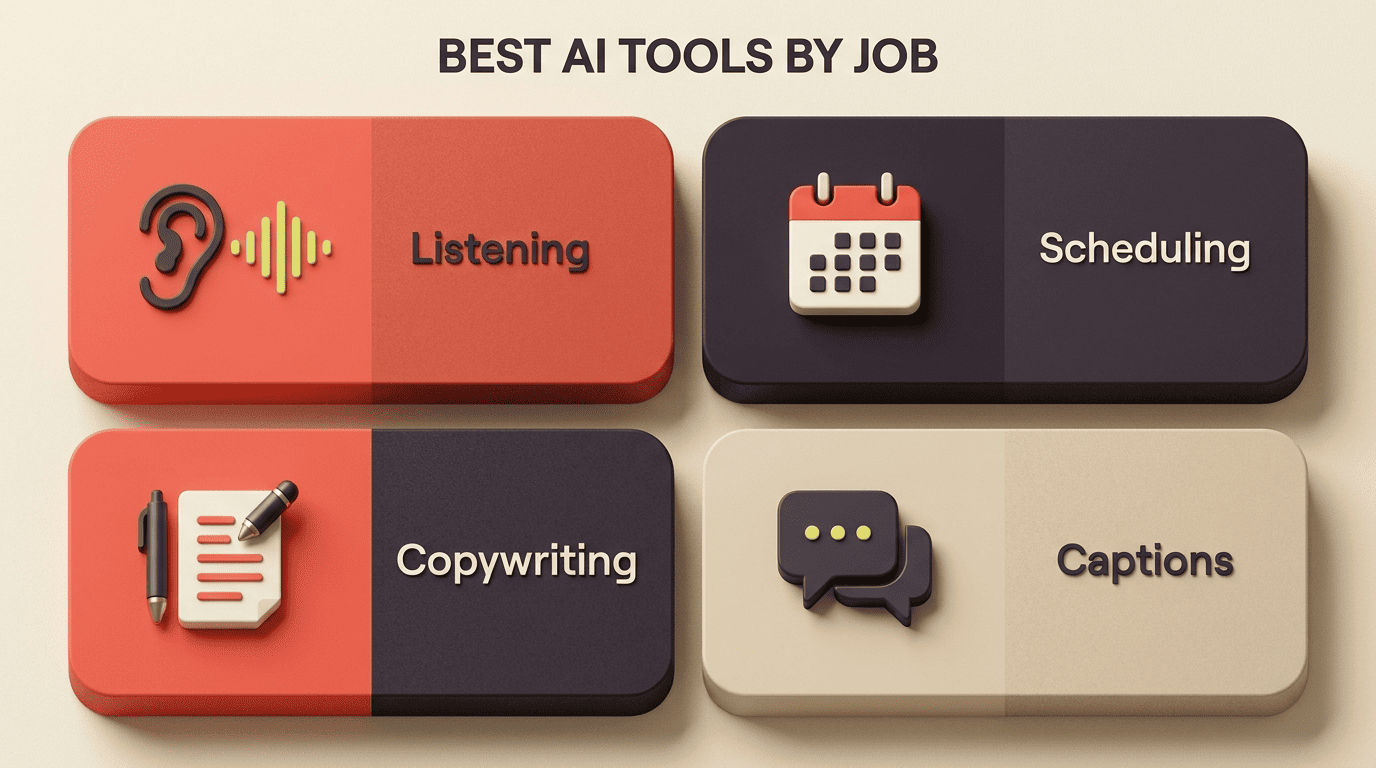
The market sorts into four broad categories. For listening and analytics, marketers lean on Sprout Social, Brandwatch, and Brand24. For scheduling and publishing, Buffer, Hootsuite, and Planable dominate. For copywriting, Jasper, Copy.ai, and Writer lead. For caption writing, tools such as Anyword — which scores captions on predicted performance before you post — and ContentStudio fill the gap.
| Job to be done | Category | Representative tools |
|---|---|---|
| Monitor mentions and sentiment | Listening/analytics | Sprout Social, Brandwatch, Brand24 |
| Plan and publish posts | Scheduling | Buffer, Hootsuite, Planable |
| Write long and short copy | Copywriting | Jasper, Copy.ai, Writer |
| Generate platform captions | Caption writing | Anyword, ContentStudio |
If you are active on five or more networks, prioritize broad integration coverage; if you focus on one or two, a specialized tool usually outperforms the all-in-one generalists.
Keeping AI Content Authentic (and Compliant)
The fastest way to waste an AI investment is to publish content that sounds like everyone else’s. Authenticity is now a competitive advantage, precisely because so much AI output has flattened into sameness. The fix is to feed the model your brand voice, real examples, and clear guardrails — then edit every draft as if a person wrote the first pass.
Compliance runs alongside authenticity. Marketers must watch data-privacy rules such as the EU’s General Data Protection Regulation and California’s CCPA when AI touches customer data, and stay alert to algorithmic bias in targeting and recommendations. Where platforms or regulators require it, disclose that content is AI-assisted. Across every use case, human oversight stays the default setting — the moment it slips, quality and trust slip with it.