
AI for Marketers: How to Deliver Personalization at Scale
Personalization at scale means using AI to tailor messages, offers, and experiences to each individual customer automatically, even when you are talking to millions of people at once. If you want an AI marketing mentor to walk you through it, the core idea is simple: automation supplies the scale, and your data supplies the intelligence.
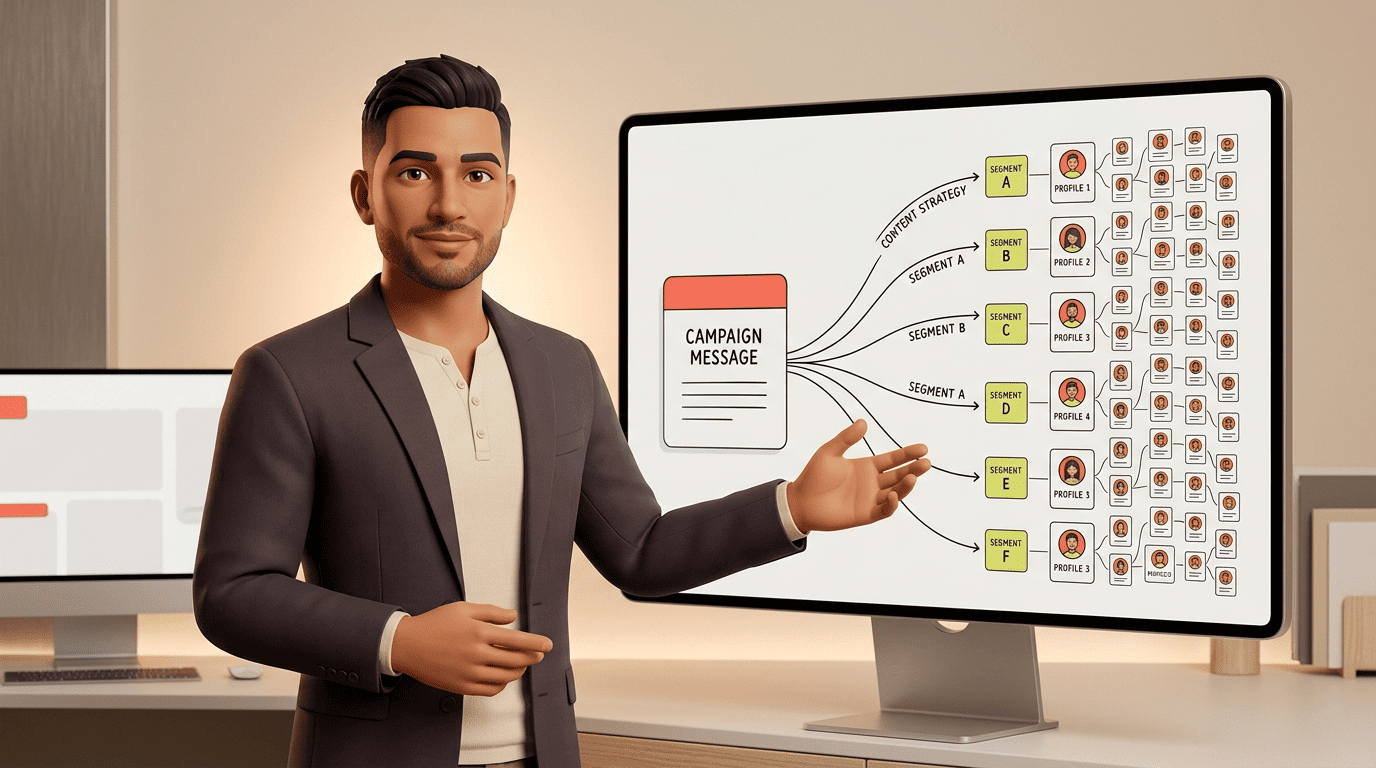
What used to be impossible is now the baseline expectation. Research from McKinsey found that 71% of consumers expect personalized interactions, and 76% get frustrated when brands fail to deliver them. This guide breaks down what personalization at scale really is, why it matters right now, the five capabilities that power it, and a practical workflow to put it to work.
What «Personalization at Scale» Actually Means
Personalization at scale is the practice of delivering individually relevant content to a large audience without manually building each message. Traditional personalization split your audience into a handful of broad segments. AI-driven personalization goes further, treating each customer as a «segment of one» who receives their own content, timing, and channel.
The difference comes down to how decisions get made. Rules-based personalization relies on fixed if-then logic that a marketer writes by hand. AI-driven personalization uses models that learn from behavior and adjust on their own, which is why it keeps improving as more data flows in.
Why it was impossible before AI
Addressing small consumer groups with custom content was historically cost-prohibitive and practically unworkable. Building a unique message for every micro-audience took more hours than any team had.
Generative AI removes that ceiling. It produces tailored content at high volume and speed for a fraction of the old cost, which is why practitioners describe the shift as «scaling the unscalable.» The intelligence comes from data that is constantly learning, and the scale comes from automation.
From segments to segments-of-one
The move from segments to segments-of-one is the heart of hyper-personalization. Instead of grouping thousands of customers into a «loyal shoppers» bucket, AI models can weigh each person’s purchase history, browsing behavior, and channel preference separately.
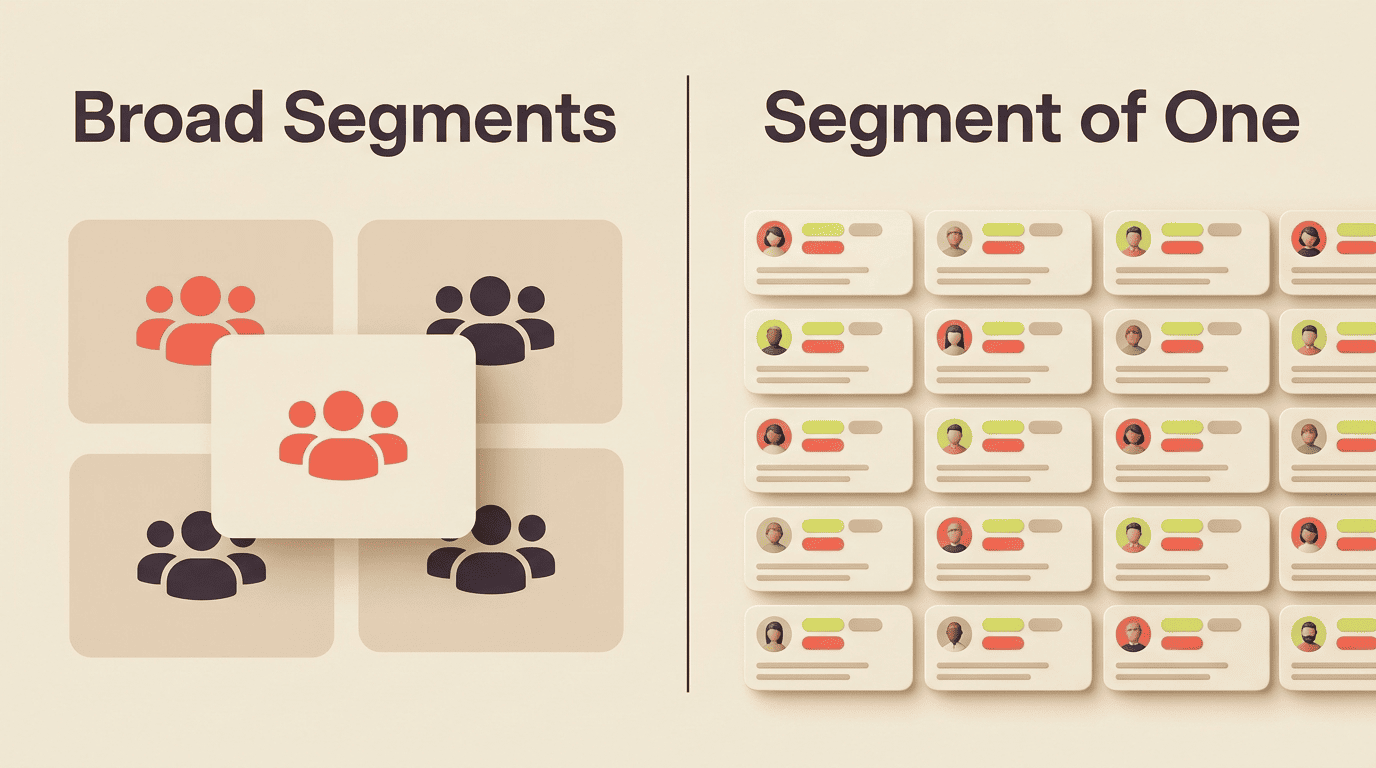
That granularity is what makes one-to-one experiences feel genuinely relevant rather than generic. A well-tuned system can decide not only what to say, but when and where to say it for each recipient.
Why It Matters Now: The Expectations Gap
Customer expectations have outrun what manual marketing can deliver. The gap between what people want and what most brands provide is now a competitive battleground, and AI is the tool closing it.
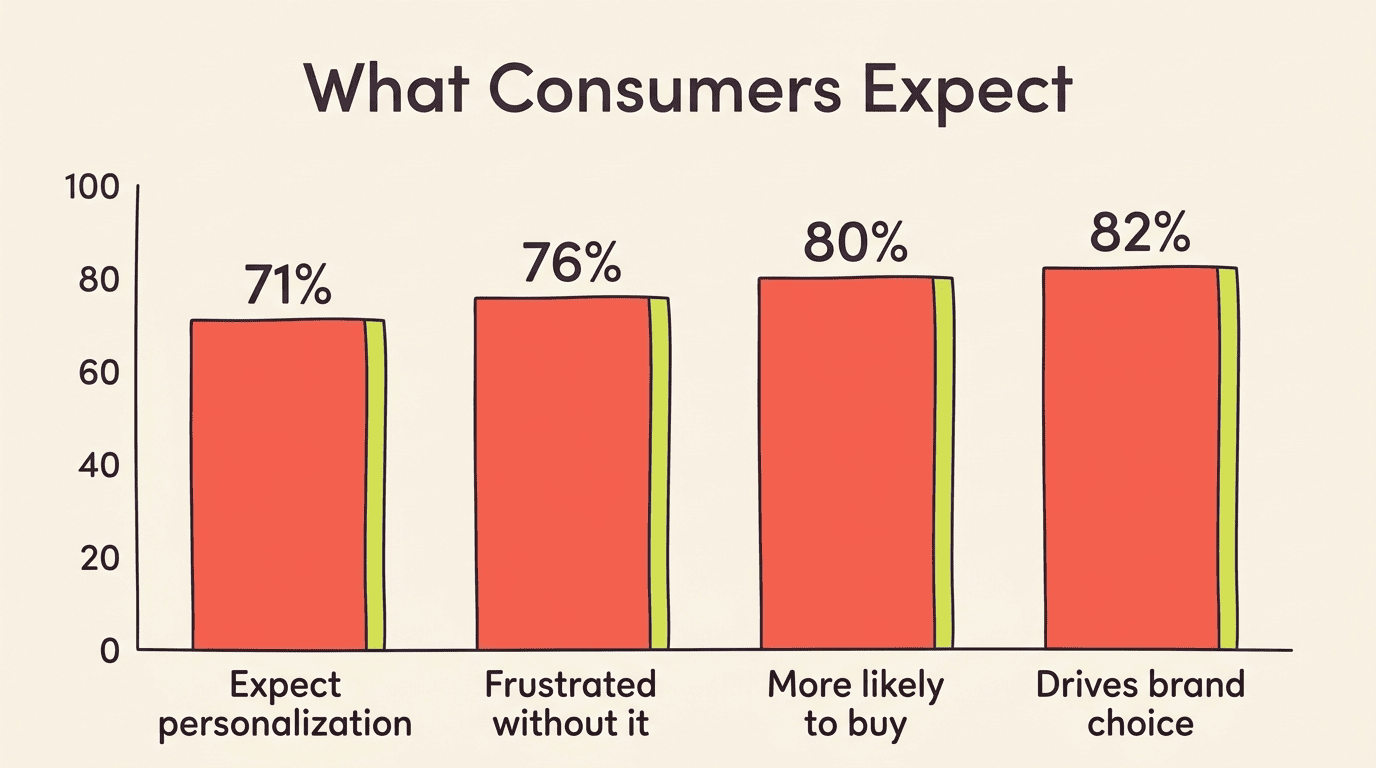
The numbers make the stakes concrete. Consider what today’s buyers expect and reward:
- 71% of consumers expect personalized interactions with companies (McKinsey).
- 76% become frustrated when they do not receive personalized content (McKinsey).
- 80% are more likely to purchase from brands that deliver personalized experiences (Deloitte).
- 82% say personalization drives their brand choice (Medallia).
The competitive stakes
Personalization is no longer a differentiator you can postpone. According to Segment’s research, 92% of organizations already use AI for personalization, so a brand that waits is falling behind an established norm rather than experimenting at the edge.
The difficulty is rising too. SAP Emarsys reports that 65% of marketers say customer behavior has become harder to predict, which means static, hand-built segments decay faster than teams can maintain them. AI-driven personalization is how marketers keep up with behavior that shifts week to week.
The value of getting personalization right, or wrong, is multiplying. Those who create direct, personal relationships across physical and digital channels stand to reap the greatest rewards.
McKinsey & Company
How AI Powers Personalization at Scale: 5 Core Capabilities
AI personalization is not a single feature but a stack of capabilities working together. Each one handles a different part of the job, from predicting what a customer will do next to generating the content they see and choosing the channel that reaches them.
| Capability | What it does | Example |
|---|---|---|
| Predictive analytics | Forecasts value, churn, and next action | Netflix cuts churn with recommendations |
| Generative AI | Creates copy, subject lines, visuals | On-brand emails at high volume |
| AI segmentation | Builds dynamic micro-segments | Real-time «segment of one» |
| Recommendation engines | Suggests products and content | Amazon-style product recs |
| Cross-channel orchestration | Picks best channel and timing | Smart sending by channel affinity |
Predictive analytics and generative content
Predictive analytics is the forecasting layer. Models estimate customer lifetime value, flag churn risk, and recommend the next best action, then rank which channel each person is most likely to engage with. Netflix’s recommendation system is the classic proof point, reportedly saving the company around $1 billion a year by reducing churn.
Generative AI is the production layer. It writes subject lines, body copy, and calls to action, and adapts tone and imagery to match both your brand voice and the individual’s data. That is what lets a small team produce thousands of on-brand variations without burning out.
Segmentation, recommendations, and orchestration
AI-driven segmentation replaces static lists with dynamic micro-segments that update in real time based on behavior. Recommendation engines then act on those signals, surfacing the products or content most likely to convert, with purchase history serving as one of the strongest inputs.
Cross-channel orchestration ties it together. A unified customer profile syncs across email, SMS, push, web, and app, and the system uses channel affinity to send each message where and when it will land best. The result is a coordinated experience rather than disconnected blasts.
Real-World Use Cases and Examples
The theory holds up in production. Across ecommerce, media, and apps, teams using AI personalization report gains that show up directly in revenue and engagement, not just vanity metrics.
Ecommerce and email results. Travel brand Luxury Escapes saw a 10% revenue uplift per user and a 7% increase in transaction value after adopting AI-driven personalization. Fitness app 8fit achieved a 3.75x conversion lift while sending 100,000 fewer emails per week, proving that relevance can beat volume.
Retention and engagement wins. Finance app Cleo drove a 284% lift in app opens and a 124% increase in push engagement, alongside a sharp drop in opt-outs. Optical retailer Now Optics reported a 5-10% lift in email open rates from automated, personalized content.
Dynamic web, chatbots, and localization. Beyond email, AI powers dynamic landing pages, programmatic SEO, and global localization that adapts content to each visitor’s language and context. Conversational AI is surging too: chatbots drove a 42% increase in usage during the 2024 holiday shopping season, according to Reuters.
How to Implement AI Personalization: A 5-Step Workflow
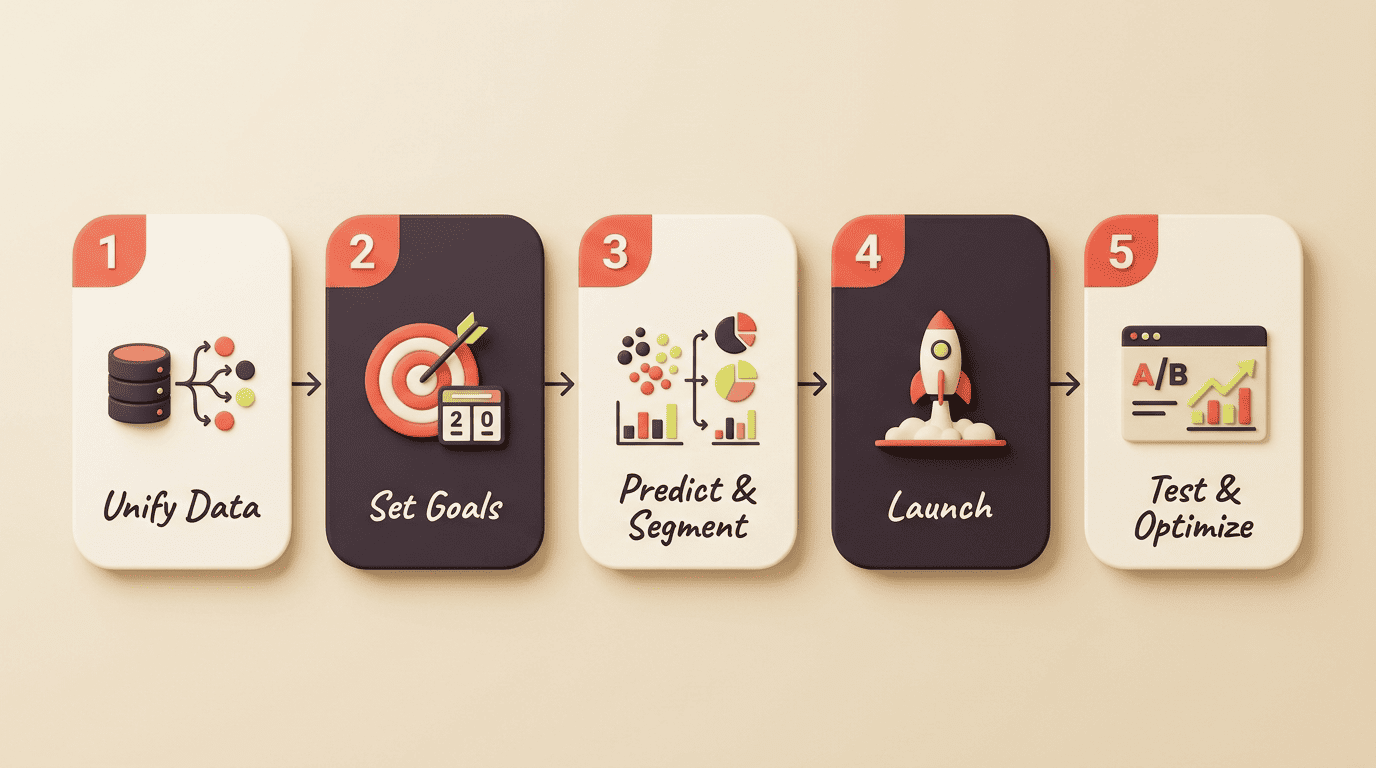
Getting started is less about buying one tool and more about sequencing the work. This five-step workflow moves you from scattered data to a self-improving personalization engine:
- Unify your data. Bring behavioral, transactional, and profile data into a single customer data platform so every model works from one source of truth.
- Set clear goals. Pick a primary objective, such as retention, average order value, or conversion, before you automate anything.
- Predict and segment. Let AI forecast behavior and build dynamic segments instead of maintaining static lists by hand.
- Launch personalized campaigns. Deploy automated messages with tailored content and optimal send timing for each recipient.
- Test and optimize continuously. Run automated A/B tests and control groups so the system keeps learning and improving without manual tuning.
The order matters. Skipping the data-unification step is the most common reason personalization programs stall, because even the best model produces weak output when it draws from fragmented, contradictory records.
Start small and prove value
You do not need to personalize every channel on day one. Choose one high-impact use case, such as an abandoned-cart email flow or a homepage product recommendation, and instrument it well enough to measure the lift.
Once you can show a clear revenue or engagement gain from that first workflow, expanding to new channels becomes far easier to justify. A proven pilot turns personalization from a cost center into an obvious investment.
Measuring ROI and Managing Risks
Personalization pays off, but only if you can measure it and run it responsibly. The upside is well documented, and so are the risks that come with using customer data at scale.
The measurable payoff
McKinsey’s analysis puts hard numbers on the return. Personalization can lift revenue by 5-15%, raise marketing ROI by 10-30%, and lower customer acquisition costs by as much as 50%. Companies that excel at it generate roughly 40% more revenue from those activities than average performers.
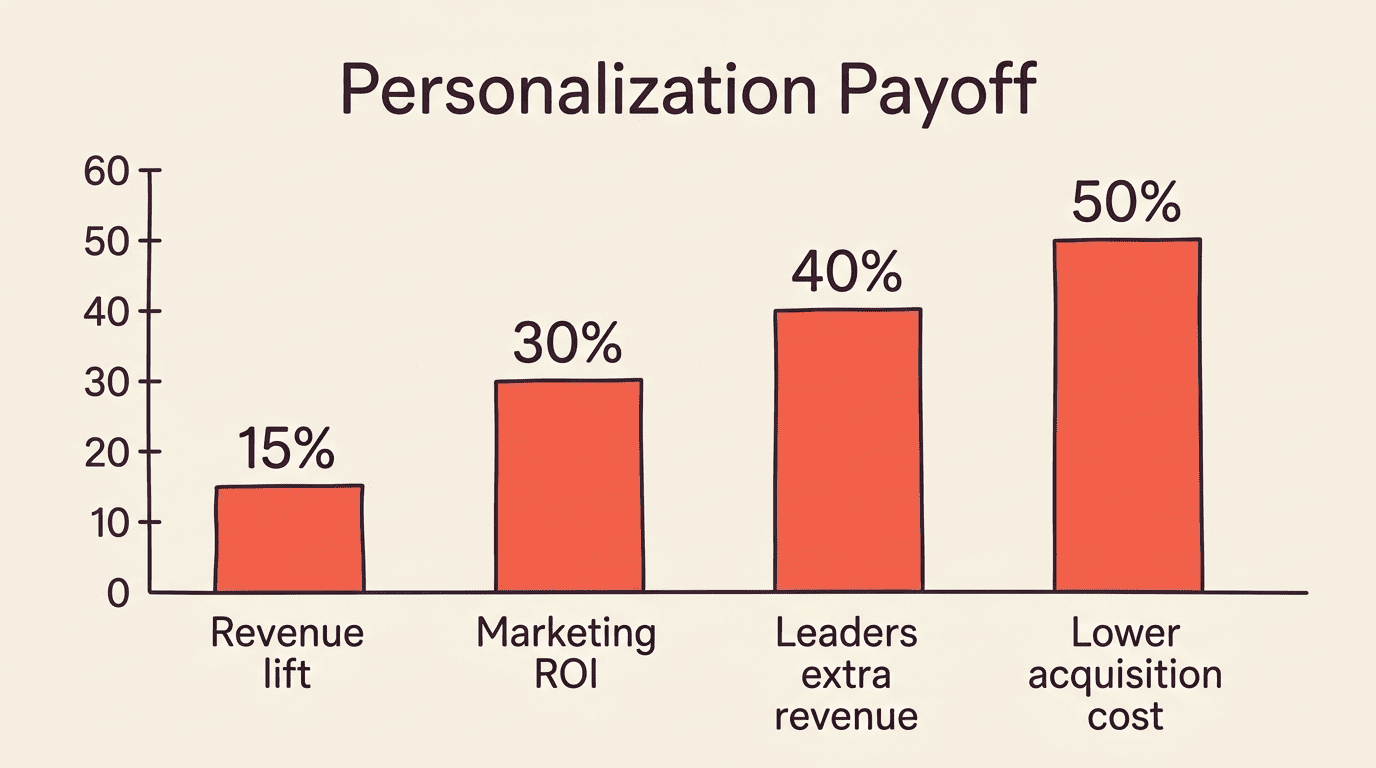
To capture that value, track a layered set of metrics: engagement signals like open and click-through rates, conversion and revenue impact, and longer-term measures like retention and customer lifetime value. Insights from autonomous testing then feed back into the next round of optimization.
Privacy, trust, and the human touch
Data privacy and consent are the foundation, not an afterthought. Being transparent about how you collect and use customer data is what keeps personalization from tipping into something that feels invasive, and it protects you as regulations tighten.
AI should also amplify human judgment rather than replace it. The strongest programs pair automation with a marketer’s strategy and empathy, keeping a human connection in the experience even when the delivery is machine-driven. Balance is the difference between personalization that builds loyalty and automation that erodes it.
FAQ
Related guides: AI audience segmentation and programmatic and AI-powered SEO.