
AI for Marketers: Prompt Engineering and Prompting Skills
Prompt engineering is the single highest-leverage skill in AI for marketers today — the gap between an AI that spits out generic filler and one that writes on-brand, ready-to-ship copy. It isn’t coding; it’s making your thinking explicit enough for a model to follow.
The gap is bigger than most teams admit. Industry surveys consistently find that only a small share of marketing teams feel fully equipped to use AI tools effectively, even as the large majority already use or plan to adopt generative AI within the next year and a half. When everyone has the same tools, prompting skill becomes the real differentiator.

What Prompt Engineering Means for a Marketer
Prompt engineering is the practice of writing clear, structured instructions so a generative AI model produces useful, on-brand output instead of generic filler. It sits closer to briefing a freelancer than to writing code — the model needs the same clarity a new hire would need on their first day.
McKinsey’s 2024 State of AI survey found that 65% of organizations now use generative AI regularly in at least one business function — nearly double the share from the year before — with marketing and sales among the functions showing the sharpest rise in adoption. Wikipedia’s entry on prompt engineering describes it as the process of structuring text so it can be interpreted and understood by a generative AI model — a definition that holds whether you’re using ChatGPT, Claude, or Gemini.
Prompt engineering means designing clear, structured instructions so GenAI produces useful, on-brand output. For marketers it’s less «speaking tech» and more making your creative brief explicit — the same discipline you’d use writing a brief for a designer or copywriter, just addressed to a model instead of a person.
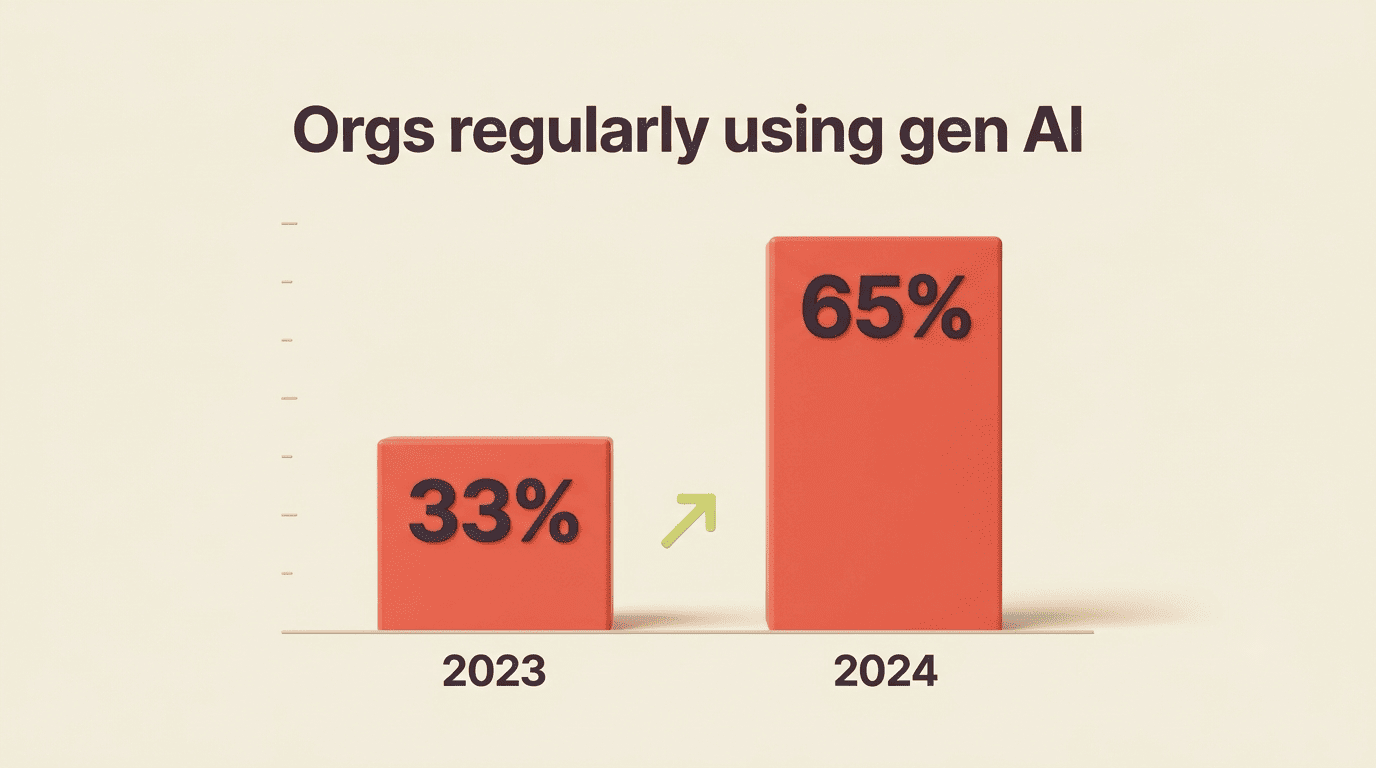
Adoption has moved faster than skill. Most marketing teams have already picked up an AI tool, but far fewer feel genuinely confident using it well. Three things explain the gap:
- Tool access is now universal, but structured training on how to instruct the tools is not
- Teams that never move past one-line prompts get generic, off-brand drafts and blame the model instead of the prompt
- Marketing and sales is the fastest-growing gen AI use case inside organizations, which means the teams with the strongest prompting skills pull ahead fastest
That last point is why prompting has become a hire-able, trainable competency inside marketing teams rather than a personal quirk of whoever «gets» AI.
The Anatomy of a Good Prompt
A good prompt has a fixed structure, whether it’s for ChatGPT, Claude, or Gemini: role, task, context, and output format. Skip any one of these four pieces and the model has to guess — and guessing is what produces generic, off-brand drafts.
Four building blocks
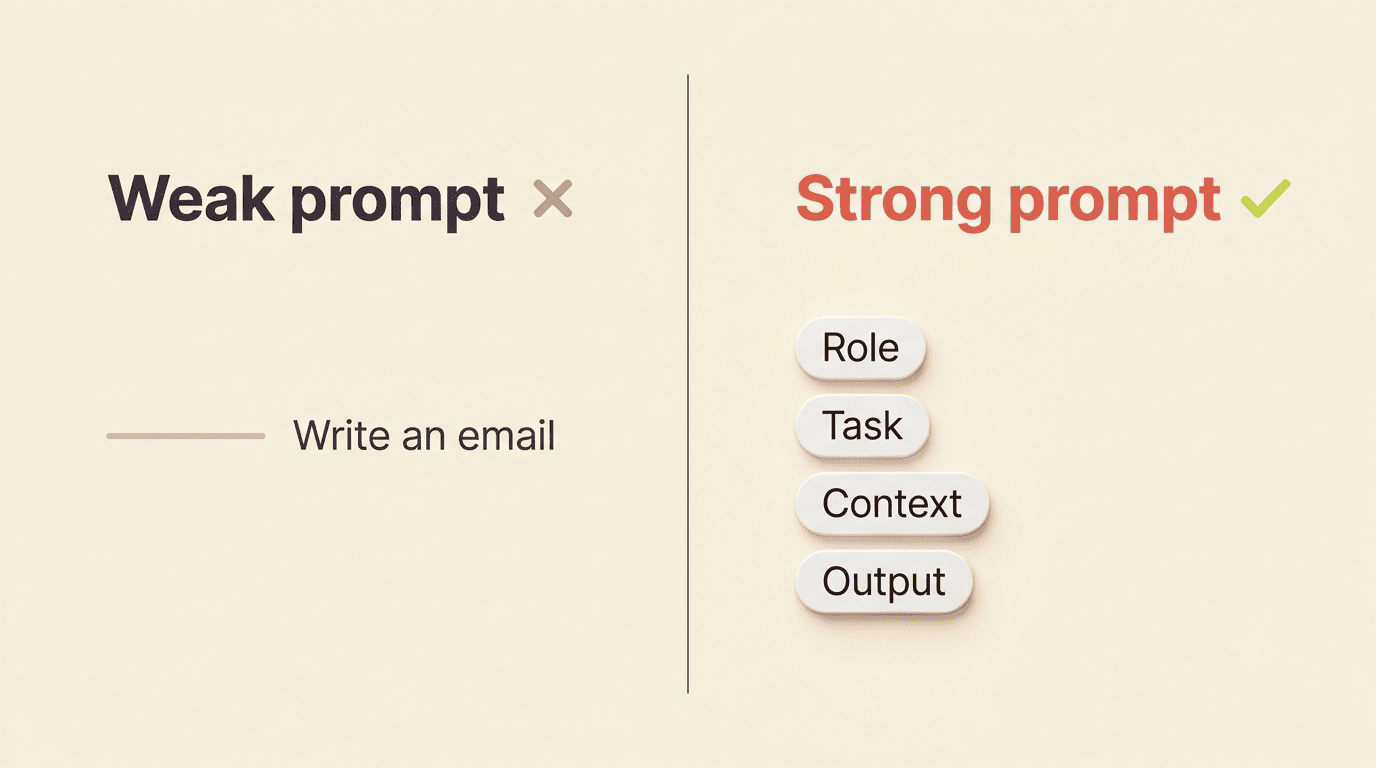
Every strong prompt has four parts: instructions (what you want done), context (brand voice, audience, tone), input data (the raw material — product specs, past campaigns, customer quotes), and output indicators (format, length, structure). A weak prompt reads: «Write a product email.» A strong version reads: «Write a 150-word product announcement email for busy small-business owners, in a confident but friendly tone, highlighting the one-click setup feature, ending with a single CTA button labeled ‘Try it free.'» The second version removes almost all ambiguity.
Role, task, context, output
The reusable pattern behind most effective marketing prompts is role, task, context, output. Assign a role («You are a senior email marketer for a B2B SaaS company»), state the task clearly («write a re-engagement email»), give context (audience, product, tone, past performance), and specify the output (word count, format, CTA). A before-and-after makes the difference concrete: «Write an ad» produces three bland sentences; «You are a performance marketer. Write three 25-word Google Search ad headlines for a project-management tool, targeting freelancers, emphasizing speed of setup, no exclamation points» produces headlines you can ship the same day.
Prompt Frameworks Worth Memorizing
Two frameworks cover most marketing use cases: CLEAR for content prompts, and TRIM for data and analytics prompts.
| Framework | Stands for | Best for |
|---|---|---|
| CLEAR | Context, Limitation, Expectation, Audience, Role | Content, copy, creative briefs |
| TRIM | Task-oriented, Relevant context, Intent explicit, Measurable criteria | Data analysis, performance reporting |
CLEAR
CLEAR breaks down into Context (what’s the situation), Limitation (word count, tone restrictions, banned words), Expectation (what «good» looks like), Audience (who’s reading), and Role (who the AI is playing). It’s built for content prompts — blog intros, ad copy, email subject lines — where tone and audience fit matter more than numeric precision.
TRIM (for data/analytics prompts)
TRIM is Task-oriented, Relevant context, Intent explicit, Measurable criteria — a framework built for prompts that touch performance data rather than creative copy. An example: «Summarize last-30-day campaign performance by category; flag any campaign where ROAS dropped more than 15% and explain the likely driver.» TRIM forces you to name a measurable threshold instead of asking the model to «look for problems,» which produces vague, unusable answers.
Core Prompting Techniques
Beyond structure, a handful of prompting techniques change how the model actually reasons and formats its answer. OpenAI’s prompt engineering guide and Google’s prompting guide both treat these as foundational, not advanced.
- Zero-shot: no examples given, relies entirely on the instructions
- One-shot: a single example to anchor format or tone
- Few-shot: several examples to lock in a consistent format or brand voice
- Chain-of-thought: asking the model to reason step by step before producing a final answer
Zero-, one-, and few-shot
Zero-shot prompting gives the model no examples — just instructions. One-shot gives a single example. Few-shot gives several examples, which is the fastest way to enforce a consistent brand voice: paste three on-brand product descriptions before asking for a fourth, and the model mimics the pattern far more reliably than from instructions alone.
Chain-of-thought and advanced moves
Chain-of-thought prompting asks the model to reason step by step, which noticeably improves output quality on anything involving comparison, prioritization, or multi-step logic — like ranking campaign ideas against a budget. Layer on persona instructions («respond as a data-driven CMO»), negative instructions («do NOT use jargon or exclamation points»), multi-step workflows (outline, then draft, then tighten), and self-critique loops («review your draft against the brand voice guide and revise») for the highest-quality output.
Here’s a quick way to put these techniques into practice:
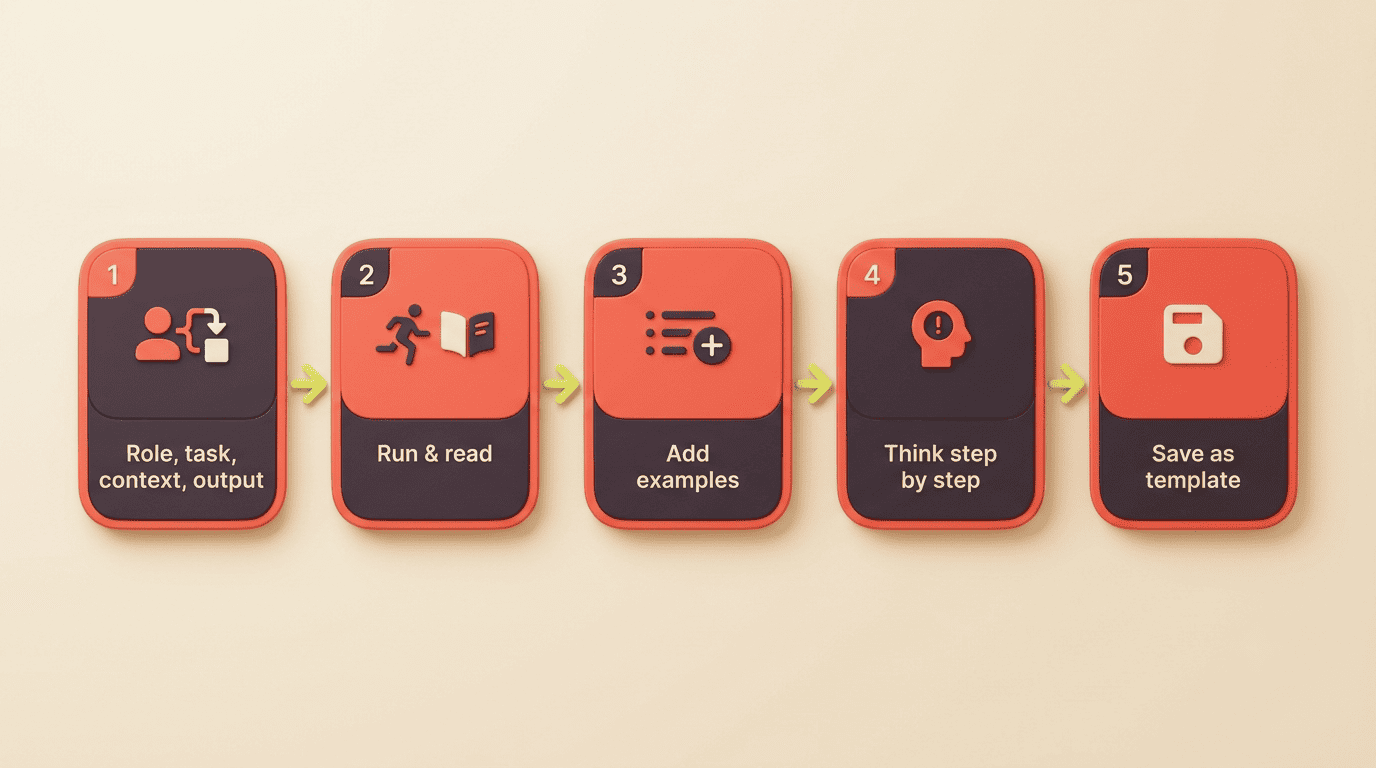
- Start with role, task, context, output — no example yet
- Run the prompt once and read the result critically
- If tone or format is off, add two to three examples (few-shot)
- If reasoning is shallow, add «think step by step before answering»
- Add explicit negative instructions for anything you keep having to delete
- Ask the model to self-critique the draft against your brand guidelines
- Save the working version as a template for the next campaign
Marketing Prompt Templates That Work
Reusable templates turn one good prompt into a repeatable asset the whole team can use — instead of every marketer reinventing the wheel for every campaign.
Reusable templates by task
A few fill-in-the-blank templates cover most recurring marketing work:
- Ad copy: «Write three [platform] ad headlines for [product], targeting [audience], emphasizing [benefit], under [character limit].»
- Email: «Create a product announcement for [feature] targeting [segment], highlighting [benefit], addressing [pain point], in 150 words.»
- Social post: «Write a [platform] caption for [campaign], in [tone], with a call-to-action to [desired action].»
- Content brief: «Outline a blog post on [topic] for [audience persona], covering [subtopics], with an SEO focus on [keyword].»
The payoff
The payoff for building these templates shows up in the numbers. Salesforce’s own marketing research has found personalized subject lines lifting open rates by roughly a quarter compared to generic sends, and industry benchmarks consistently point the same direction: well-briefed, personalized AI copy outperforms generic AI copy on both opens and clicks. Teams using structured templates report first drafts produced significantly faster, and editing time drops noticeably once brand guidelines are baked directly into the prompt instead of applied after the fact.
The hottest new programming language is English.
Andrej Karpathy, former OpenAI/Tesla AI lead
That line applies almost exactly to marketing prompts: a one-off good prompt saves you an afternoon, but a saved, reusable template saves the whole team every week after.
Common Mistakes and How to Fix Them
Most weak AI output traces back to a handful of repeatable mistakes, not a limitation of the model itself:
- Generic one-liners with no role, context, or output format
- Vague asks that never specify audience or tone
- Prompts that ignore where the reader sits in the customer journey
- Publishing AI output without a fact-check pass
Generic one-liners produce generic output. «Write a blog post about email marketing» gives the model almost nothing to work with, so it defaults to the blandest, most averaged-out version of the topic. The fix is always the same: replace the one-liner with the full role-task-context-output pattern before you hit send.
Vague asks skip the details that matter. A prompt with no stated audience or tone forces the model to guess, and it usually guesses wrong for your brand. Naming the audience segment and the tone in one added sentence fixes most of this.
Ignoring the customer journey stage produces mismatched copy. A prompt for a cold-traffic ad and a prompt for a loyal-customer win-back email should never look the same — yet teams often reuse the same generic prompt for both. Naming the funnel stage explicitly in the prompt keeps the output relevant to where the reader actually is.
Skipping the fact-check pass is the costliest mistake. AI hallucinates — it can generate confident-sounding statistics, quotes, or claims that are simply wrong. Prompting speeds up drafting, not fact-checking, so every number, name, and claim that comes out of a marketing prompt needs a human check before it goes into a campaign, a landing page, or a press release.
Measuring and Improving Your Prompts
Treat your best prompts the way you’d treat a winning ad variant: A/B test opening lines, change one variable at a time so you know what actually moved the result, and save winners as shared team templates rather than personal notes. Marketers who systematically test and refine prompts consistently report meaningfully higher conversion rates and stronger sales response compared to generic, unrefined prompts, alongside content production times cut substantially once the winning prompts are standardized across the team.
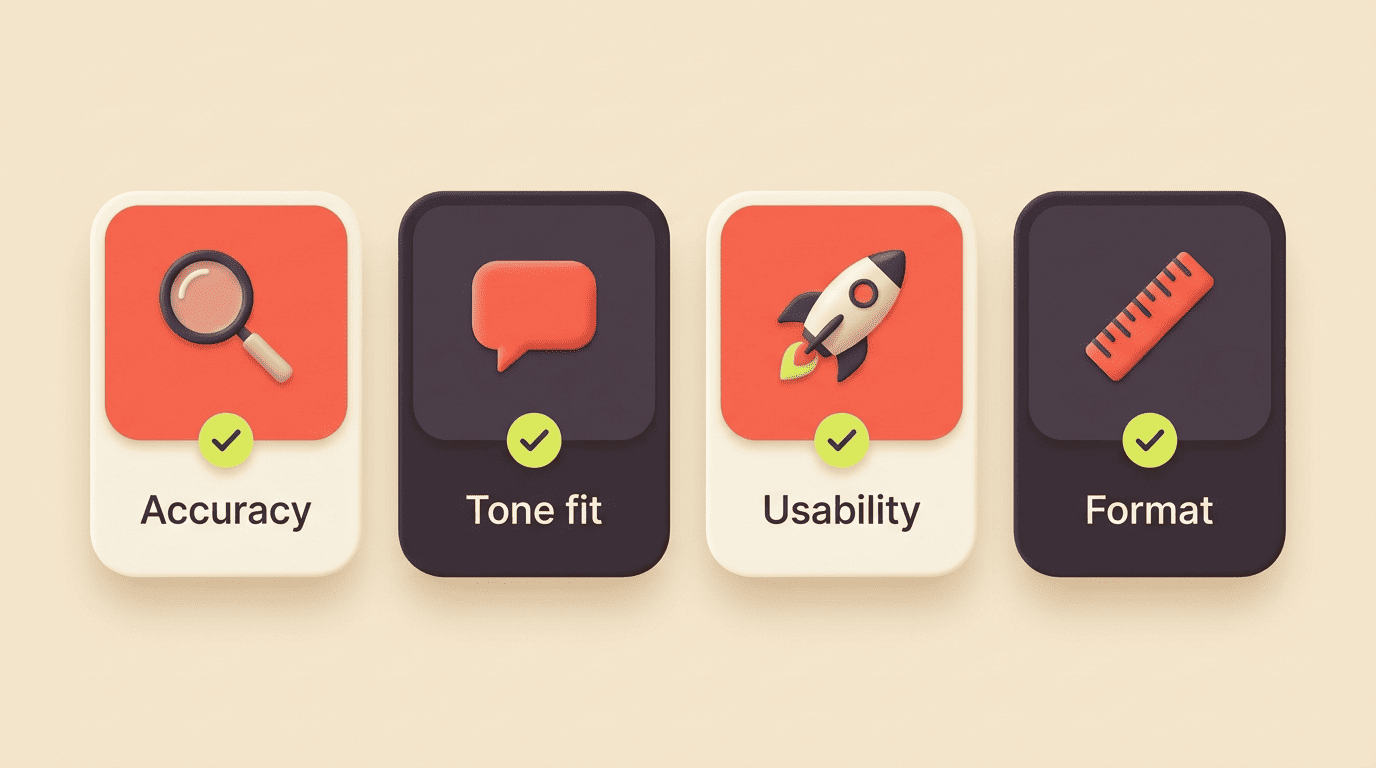
Score every AI draft against the same simple rubric before it goes anywhere near a template library:
| Criterion | What «good» looks like |
|---|---|
| Accuracy | Every number, name, and claim checks out against a source |
| Tone fit | Reads like the brand, not like a generic AI draft |
| Usability | Ships with zero or near-zero edits |
| Format compliance | Matches the requested length and structure exactly |
A prompt that reliably scores well across all four criteria is the one worth saving as a shared team template.
FAQ
Related guides: AI email marketing and AI marketing workflows.